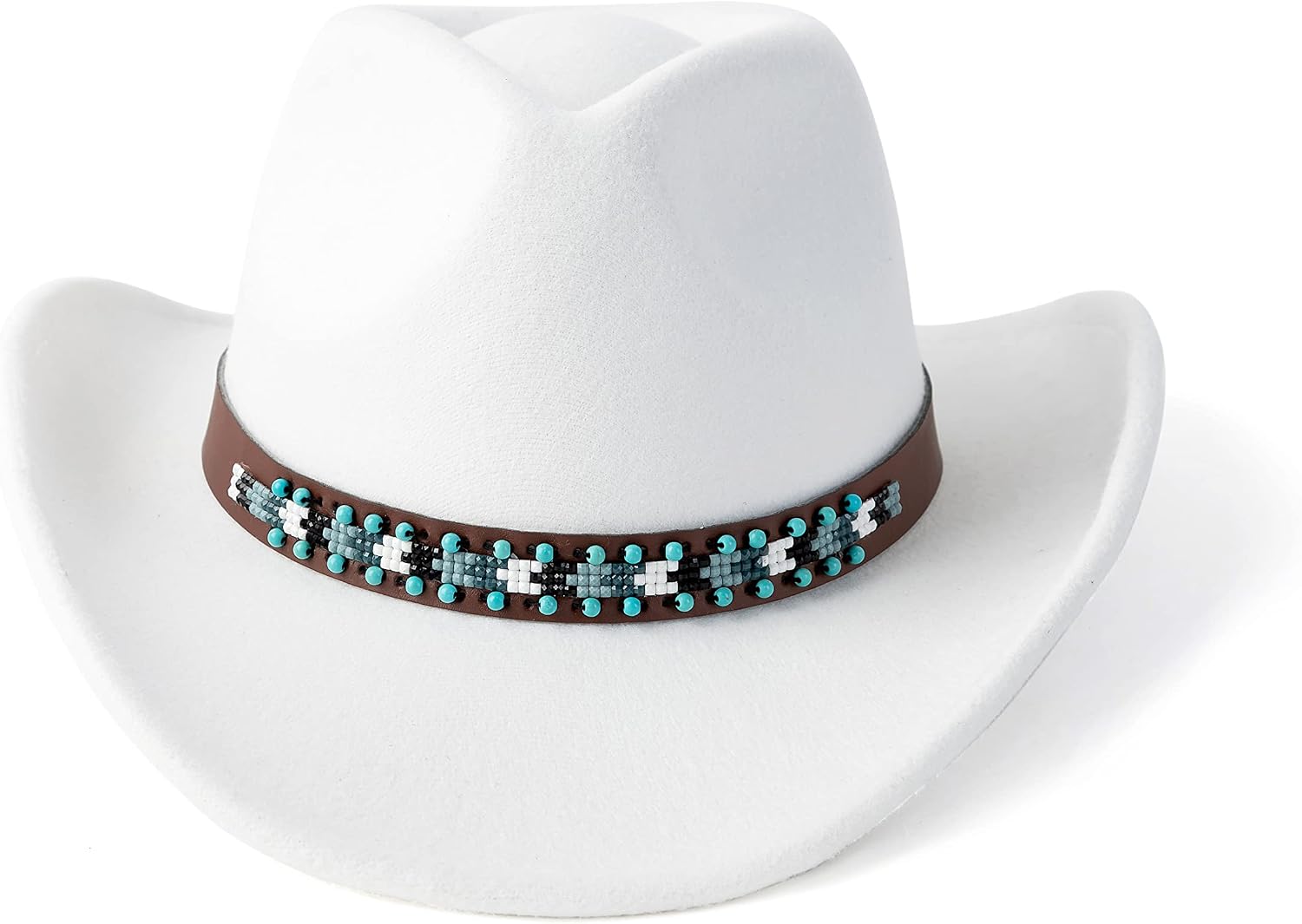
If you’ve ever stood in a hat aisle holding something that looks vaguely like a cowboy hat and wondered whether it’s going to wilt by noon or hold its shape through a full day at an outdoor festival — you’re in the right place. Western hats for women come in two main material families: straw (woven plant fibers that are lightweight and breathable, designed for warm-weather wear) and felt (compressed wool or fur fibers that hold a crisp shape and handle cooler temperatures). Each material serves different occasions, different price points, and different levels of longevity. This guide will walk you through exactly when straw makes sense, when to make the switch to felt, how to evaluate shapeable brims (the key feature that lets you customize a hat’s silhouette to your face), and what you’re actually paying for as the price climbs from $40 to $600.
Whether you’re dressing for a country concert next weekend or building a year-round western wardrobe that includes real investment pieces, the decision framework here will keep you from buying the wrong hat twice.
Straw vs. Felt: The Decision Isn’t Just About Season
The conventional wisdom is simple: straw in summer, felt in fall and winter. That’s not wrong, but it’s incomplete — and for a reader building a real wardrobe or advising clients, incomplete rules cost money.
Straw encompasses a range of woven materials. The most common in the western category are:
- Toyo straw — a paper-based fiber woven tightly into a smooth finish. Affordable, widely available, and comfortable. Most hats in the $28–$80 range are toyo. They’re seasonally disposable and not meant for hard reshaping.
- Parisisal — a finer, more open weave made from sisal fibers (derived from agave). Lighter and more breathable than toyo, it’s common in the $90–$200 range and holds detail better at the brim edge.
- Seagrass and raffia — natural plant fibers with an organic, textured appearance. Trending heavily in 2025–2026 per Vogue’s western hat coverage; raffia in particular is appearing in elevated western silhouettes from independent milliners.
- Shapeable straw — any of the above that’s been treated or woven with enough flexibility to allow hand-reshaping of the brim. This is the feature to prioritize if you want a hat that can be adjusted to complement your face shape. Not all straws qualify; check whether the product description explicitly calls it out.
Felt in the western category means either:
- Wool felt — pressed and steamed wool fibers. Durable, workable, and available at every price point from $60 (basic) to $300+ (quality wool with hand-blocking). This is the practical year-round felt for most buyers.
- Fur felt — made from beaver, rabbit, or mixed fur fiber. Noticeably softer, denser, and more water-resistant than wool. A properly graded fur felt hat will shed light rain, hold a crease for years, and develop a patina with wear. This is the felt that justifies $350–$800 price tags from makers like Gladys Tamez or Stetson’s upper-tier lines.
The real decision axis isn’t temperature — it’s occasion formality and longevity expectation. A raffia western hat at a country music festival in June is perfect. That same hat at a ranch wedding in October looks underdressed and may not survive a dewy evening. Felt reads as more intentional, more finished, and more occasion-appropriate once the context shifts toward celebration or cooler ambiance.
By the Numbers: What You’re Buying at Each Price Point
| Price Range | Typical Material | Shapeable Brim? | Longevity Expectation |
|---|---|---|---|
| $28–$80 | Toyo or basic seagrass | Sometimes | 1–2 seasons |
| $80–$175 | Parisisal, finer raffia | Usually | 2–4 seasons with care |
| $175–$350 | Quality wool felt or shapeable straw blend | Yes | 5–10 years |
| $350–$800+ | Fur felt, hand-blocked; bespoke straw constructions | Yes (hand-shaped) | Indefinite with storage |
Who What Wear’s 2025 western hat roundup notes that the jump from the $80–$175 tier to the $175–$350 tier is where construction quality becomes visible — tighter weave density, reinforced brim edges, and interior sweatbands that actually conform to the head rather than gap at the temples.
Shapeable Brims: What They Are and How to Evaluate Them
A shapeable brim is woven or constructed with enough flexibility that you can bend the brim upward on the sides (a “cattleman” curve), push it down in front for a dramatic face-framing effect, or flatten it completely for a wide-open silhouette. This matters for two reasons: proportion and personal style.
Proportion is the practical reason. Hat-to-face fit isn’t just about head circumference — it’s about how the brim’s width and angle interact with your face shape and shoulder width. Harper’s Bazaar’s cowboy hat styling guide makes the point that a rigid flat brim on a narrow face can overwhelm; being able to angle the brim slightly upward on each side immediately softens the effect. Without a shapeable brim, you’re buying a fixed silhouette and hoping it works.
Personal style is the creative reason. The same hat shaped with a wide flat brim reads prairie-romantic; curve it up on both sides and it reads classic western; push the front brim down low and it reads fashion-forward and slightly dramatic. You’re buying one hat with multiple wearable identities.
How to evaluate shapeability before buying:
- Look for explicit language: “wire-brim,” “shapeable,” “bendable brim,” or “memory wire edge.” A wire embedded in the brim edge is the most reliable shaping mechanism.
- At the upper end of the straw tier and across all felt hats, shaping is done by hand (and by your milliner or hat block) using steam. If you’re spending $300+, you should be purchasing from a maker or retailer who will either block it to your specification or offer steaming guidance.
- Avoid conflating “floppy” with “shapeable.” A very fine parisisal hat may drape softly but won’t hold a position once shaped — it returns to flat. True shapeability means the brim stays where you put it.
Elle’s 2024 cowgirl hat coverage flagged this as the most common buyer regret in the category: purchasing a hat that looks shapeable but won’t hold a curve past the first warm afternoon.
Occasion Mapping: Which Hat for Which Moment
This is where the decision framework pays off. Run your occasion through these filters:
Country concert, outdoor music festival, summer fair → Straw is correct. Prioritize breathability over formality. Toyo or seagrass at $40–$80 is entirely appropriate; you want something you can wear hard without wincing if it gets dusty or bent in a crowd. A shapeable brim is nice but not mandatory at this tier.
Ranch wedding, rehearsal dinner, or bridal event with outdoor elements → The formality shifts the equation. A finer parisisal or a quality raffia at $100–$175 threads the needle — still warm-weather appropriate but visually elevated. Alternatively, a wool felt in a lighter colorway (cream, bone, oat) works well into the shoulder seasons and reads occasion-ready immediately. Town & Country’s western hat dressing guide specifically notes that felt in neutral tones is more versatile across dress codes than straw because it photographs crisper.
Kentucky Derby parties and race-day events with a western wardrobe angle → This is where felt earns its keep decisively. A high-quality wool felt or fur felt western hat in a classic silhouette — a well-proportioned 4-inch brim, clean crown crease — competes comfortably with more traditional Derby headwear. At this occasion level, provenance and construction quality become visible to other hat-wearers in the room. This is the context where a Gladys Tamez custom felt fedora or an upper-tier Stetson fur felt makes sense at $400–$600+.
Everyday wardrobe building (frequent wear, year-round) → Invest in felt, specifically wool felt at a minimum. The cost-per-wear math on a $200 wool felt hat worn 30+ times a year over five years is dramatically more favorable than cycling through $50 straw hats seasonally. Owners of mid-tier wool felt hats consistently report that the hat’s shape holds even after years of travel and daily handling — something no toyo straw hat can match.
When to Go Felt: The Clear Decision Rules
If you’re still weighing straw versus felt for a specific context, use these if/then frames:
If the event is outdoors, above 75°F, and lasts under four hours → straw. Comfort and breathability win.
If you’ll be photographed, the event has dress-code language like “western chic” or “resort formal,” or you’re advising a client on occasion headwear → felt, or at minimum a high-quality parisisal with a wire brim edge that holds its shape in photos.
If you’re buying once and wearing twice a year for the next decade → felt, specifically fur felt if your budget reaches $350+. Fur felt’s durability and water resistance make it the hat that survives life; reviewers consistently single out fur felt’s ability to bounce back from reshaping, humidity, and storage without permanent damage.
If budget is fixed under $100 and the occasion is a summer concert or casual gathering → buy the best shapeable straw you can find at that price. Don’t stretch into a mid-range felt hat you can’t fully care for; felt requires proper storage (a hat box or wide-open shelf, never stacked or crushed), and a buyer who won’t maintain it won’t get the longevity they’re paying for.
If you’re outfitting a bridal client or building a wardrobe for multiple western occasions annually → the portfolio answer is one quality felt ($175–$350 wool felt minimum) as the anchor piece, plus one warm-weather straw ($80–$150 parisisal or raffia) for the high-heat contexts. That two-hat foundation covers the full year without redundancy.
A Note on Sourcing: Where Independent Milliners Are Worth Seeking
The big names in western hats — Stetson, Bailey, Resistol at the accessible end; Gladys Tamez, Helen Kaminski, and Eric Javits with western-adjacent silhouettes at the upper tier — are well-documented and easy to access. But the most interesting western felt work in 2025–2026 is coming from independent hat makers who hand-block custom crowns and offer brim modifications as part of the purchase. Vogue’s western hat trend coverage has noted a meaningful uptick in bespoke western millinery, particularly from Texas- and Nashville-based makers offering fur felt hats with made-to-measure crown sizing and personalized brim shaping.
For buyers who’ve already navigated the accessible tier and are ready to invest $300–$600 in something irreplaceable: direct-from-milliner purchasing is where you get provenance, customization, and genuine craft quality that no department store western display can match. Ask any prospective maker about their blocking process, their felt sourcing (X-quality beaver felt is the benchmark to ask after), and their timeline — quality fur felt work typically runs 4–8 weeks from commission to delivery.
The right hat for a country concert and the right hat for a ranch wedding are genuinely different objects. This guide exists so you don’t have to discover that the hard way.