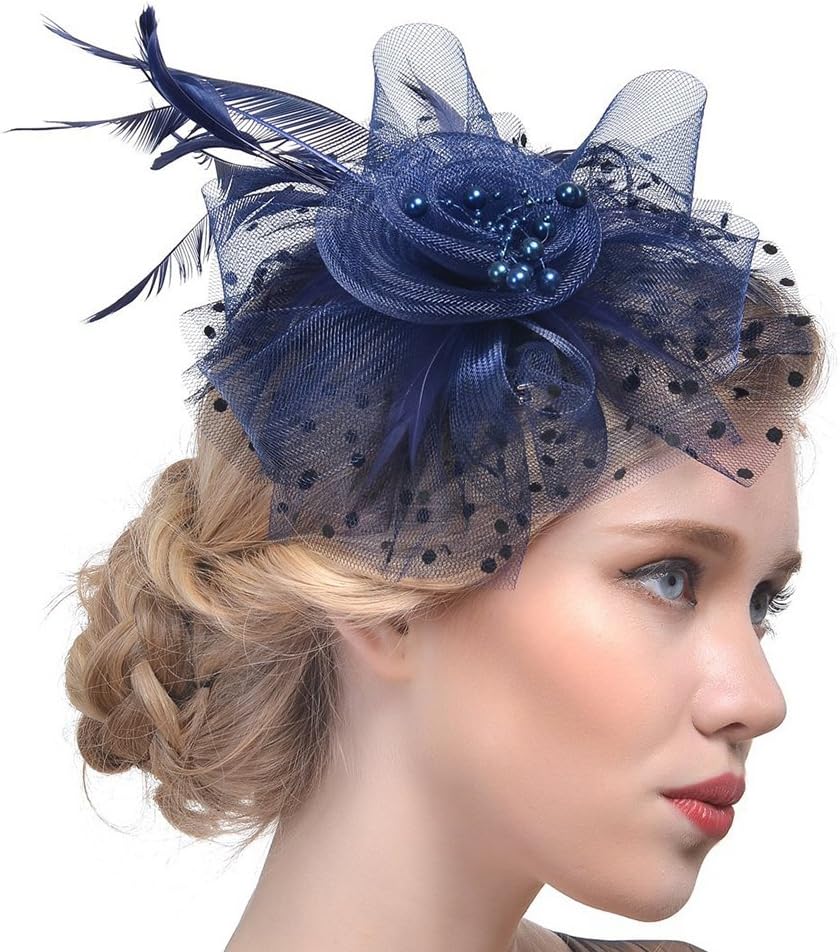
A fascinator is a small decorative headpiece — typically structured from materials like sinamay (a stiff, woven banana-fiber fabric), silk, feathers, or veiling — that attaches to the hair with a comb, clip, or band rather than sitting on the head like a traditional hat. If you’re new to the category, think of it as jewelry for your hair, but with architectural ambitions. Fascinators range from a single silk bloom pinned above one ear all the way up to dramatic sculptural confections that approach the scale of a full hat. The reason this range matters is practical: different occasions and their dress codes have real expectations about headpiece size, structure, and placement — and showing up with a delicate cocktail clip at an event that expects a proper hat (or vice versa) is the kind of mismatch that experienced stylists catch immediately. This guide is for the reader who already knows what a fascinator is and needs the decision framework: which scale, which construction, and which price tier is right for which room.
| EDITOR'S PICKZ&X Sinamay Fascinator Hat Flor… | Mid-tierBABEYOND Tea Party Fascinator H… | Budget pickDRESHOW Fascinators Hat Flower… | |
|---|---|---|---|
| Attachment | Headband + clip | — | Headband + clip |
| Material | Sinamay | — | Mesh |
| Embellishment | Floral + feather | — | Flower + feather |
| Style | Pillbox | Pillbox | — |
| Size | — | One size | 7" diameter |
| Color | Red | Nude pink | Navy |
| Price | $31.99 | $26.99 | $9.99 |
| See on Amazon → | See on Amazon → | See on Amazon → |
The Scale Spectrum: Four Practical Categories
Before mapping to occasions, it’s useful to have a shared vocabulary for size. The millinery industry doesn’t use standardized dimensions, but working stylists and milliners generally think in four tiers of headpiece scale:
Cocktail clip / mini fascinator (under 4 inches / ~10 cm): A single focal element — a bow, a flower, a feather spray, a small veil puff — pinned at the hairline or temple. Minimal structure, maximum ease of wear.
Standard fascinator (4–8 inches / ~10–20 cm): The category’s workhorse. Enough scale to read across a room, often combining base structure (a small sinamay disc or pillbox base) with decorative elements. This is the range in which most Philip Treacy cocktail pieces and the bulk of Eugenia Kim’s occasion work sit.
Statement fascinator / headpiece (8–14 inches / ~20–35 cm): Approaches hat territory. Often built on a blocked base — meaning a milliner has shaped the foundation material over a wooden form using steam, rather than sewing flat pieces together. Maison Michel and Gladys Tamez bespoke work frequently occupies this range. Requires genuine hat-wearing confidence to carry off.
Hatinator (14 inches+ or structured brim present): The Royal Ascot-era hybrid — a base large enough to shade the face, often with a small brim, but worn at an angle with a visible attachment rather than resting level on the crown. Technically not a hat, technically not a small fascinator. Dress codes treat it as a hat.
Harper’s Bazaar’s style guides consistently note that the cocktail clip and standard fascinator are the most versatile entry points, while the statement range is occasion-specific in a way that makes under- and over-dressing real risks.
Occasion Dress Codes and What They Actually Require
This is where practitioners diverge from general readers. Knowing the vocabulary of scale is only useful if you can map it to the code the invitation implies. Here are the five occasion categories where headpiece guidance is both expected and consequential.
Royal Ascot and Formal British Race Days
Royal Ascot’s Royal Enclosure Dress Code Guidelines are among the most specific published dress codes for headwear in existence. The relevant language: headpieces must have a base of at least 4 inches (10 cm) in diameter. Fascinators without a structured base — the cocktail clip category — are explicitly not permitted in the Royal Enclosure. This is the one context where the “standard fascinator” category’s 4-inch lower bound is a literal compliance threshold, not an aesthetic preference.
For Royal Ascot clients, this means: anything built on a sinamay disc or blocked base of sufficient diameter is in play; feather-only or flower-only hair clips are out. Town & Country’s race-day coverage has noted that the 4-inch rule was codified specifically in response to the mid-2000s trend of extremely minimal hair clips being positioned as fascinators. The rule closed the loophole.
The tradeoff at price: A compliant £80–£150 sinamay disc fascinator from a UK department store meets the letter of the code. A hand-blocked Maison Michel or Philip Treacy piece in the £400–£900+ range meets the spirit of it. The meaningful difference: construction. Machine-made sinamay bases are wired and glued; hand-blocked felt or straw bases are shaped under steam and hold their form in humidity, wind, and a full race day. If your client is in the Royal Enclosure for one afternoon, the budget piece is defensible. If she’s photographed at Ascot annually, the investment piece pays for itself in longevity and photograph quality.
Kentucky Derby and American Race Day Events
Vogue’s Kentucky Derby dress code breakdown notes that American race days are — with the exception of invitational enclosures — considerably less codified than their British equivalents. The operative frame is aesthetic expectation rather than rule enforcement: Derby dressing culture rewards scale and theatricality. A mini cocktail clip reads as underdressed; a full hatinator or wide-brim hat is perfectly at home.
For Derby occasions, the standard-to-statement fascinator range (4–14 inches) is the sweet spot for guests who want occasion-appropriate headwear without committing to a full hat. The practical decision point: will the wearer be seated in a box, standing in the infield, or photographed in an organized event context? Box and event photography contexts reward larger, more structured pieces. Infield and general-admission contexts reward pieces that stay put in wind and crowd — which means a tighter attachment mechanism and lower center of gravity, not necessarily smaller size.
Who What Wear’s fascinator roundups consistently highlight that secure attachment — a double comb plus a hidden grip band — is the single most-cited practical concern from occasion wearers at outdoor events. This is a construction detail, not an aesthetic one, and it’s worth confirming before any purchase.
Bridal Events: Weddings, Showers, Rehearsals
Dress codes for weddings span the full scale spectrum, but the practitioner’s calibration challenge is that bridal occasions stack multiple constraints simultaneously: the dress silhouette, the formality tier, the venue architecture, and (crucially) whether the headpiece wearer is a guest, a member of the wedding party, or the mother of the bride.
Harper’s Bazaar’s wedding hat and fascinator guidance frames it this way: the scale of the headpiece should be proportional to the formality of the event, and the guest’s headpiece should never compete with the bride. This produces a practical ceiling — statement fascinators and hatinators are typically reserved for the mother-of-the-bride or mother-of-the-groom roles, where occasion-dressing authority is expected.
For church weddings at the formal tier, a standard fascinator (4–8 inches) in neutral or complementary tones to the guest’s outfit is the default safe choice. For outdoor garden weddings or afternoon receptions, the cocktail clip or small disc fascinator is proportionate. Black-tie evening weddings are the one context where a very small, jeweled or feathered piece at the temple can outperform a daytime-scale fascinator.
Church and Sunday Dress
Church hat culture — particularly in Black American church tradition — operates on entirely different aesthetic logic than race-day or bridal codes. Town & Country’s coverage of church hat tradition describes it as a discipline of maximalism within formality: scale, color, and artistry are marks of respect and occasion-consciousness, not excess. The hatinator and statement fascinator categories sit at the conservative end of this spectrum; full brims in fur felt or blocked straw at the $300–$800 range represent the appropriate investment tier for serious occasion dressers in this context.
For wardrobe consultants sourcing for this audience, the construction detail that matters most is the hat’s ability to hold structure and color over repeated wearing and seasonal storage. Fur felt (particularly beaver or rabbit-blend felt graded by density) significantly outperforms synthetic felt in this regard. The Gladys Tamez custom felt fedora category — bespoke, blocked, with a client’s measurements built in — is the benchmark construction at the upper end of this market.
Business and Civic Occasions (Inaugurations, Award Events, Formal Receptions)
These occasions are underserved in buying guide content, which tends to cluster around racing and bridal. The relevant frame: headwear at business-civic events reads as a personal style statement, not a dress code obligation. The standard fascinator is the most legible choice — structured enough to be intentional, scaled appropriately for photography and formal seating. Materials signal seriousness: a sinamay disc with feathering reads as race-day; a blocked wool or felt base with clean lines reads as civic formality.
By the Numbers: Scale vs. Occasion at a Glance
| Occasion | Minimum Scale | Recommended Range | Price Tier to Consider |
|---|---|---|---|
| Royal Ascot (Royal Enclosure) | 4-inch base (mandatory) | Standard to Statement | $150–$800+ |
| Kentucky Derby / US Race Day | No minimum; aesthetic expectation | Standard to Hatinator | $80–$500+ |
| Formal Church / Sunday Dress | Culturally contextual | Statement to Full Hat | $200–$800+ |
| Wedding Guest | Occasion-dependent | Cocktail Clip to Standard | $50–$300 |
| Mother of Bride / Groom | High | Statement to Hatinator | $300–$800+ |
| Business / Civic Formal | No minimum | Standard | $100–$400 |
The Construction Tradeoff: When to Spend More
If you’re advising a client with a $150 budget and a $600 budget option in front of them, here’s where the difference is real and where it isn’t.
Real difference: Blocked construction vs. sewn-flat construction. A hand-blocked base holds its three-dimensional form under humidity, wind, and a long event day. Reviewers and stylists across aggregated coverage consistently note that budget sinamay pieces lose their crisp silhouette by mid-afternoon at outdoor events. This matters at Ascot, at Derby, at outdoor weddings. It matters less for an indoor evening event where the headpiece stays on for two hours.
Real difference: Attachment hardware. Investment pieces from Philip Treacy, Maison Michel, and independent milliners like Gladys Tamez are fitted with professional-grade combs and, often, custom grip systems. This is not a vanity detail — a piece that shifts throughout an event is unwearable.
Smaller difference than expected: Materials visible in photographs. Sinamay and parisisal (another natural straw weave) both photograph beautifully. The tactile and structural difference between a $90 disc and a $400 disc is significant in person; in a photograph, it is often invisible. For a client whose primary concern is occasion photography, this is worth naming honestly.
The Decision Rule
If the occasion has a published dress code with dimensional language (Royal Ascot being the clearest example), treat it as a compliance floor, not an aesthetic suggestion — and build up from the minimum, not down from the statement range.
If the occasion is American race-day, bridal, or church, scale to the formality tier of the event and the wearer’s role: guests dress one register below principals (mother of bride, honorees), and outdoor events reward attachment security over maximum scale.
If the budget question is on the table: spend at the investment tier ($300+) when the event is outdoor, photographed, and repeated annually — the construction difference in longevity justifies the math. Spend at the accessible tier ($80–$200) when the event is a one-time indoor occasion where structure holding for four hours is sufficient.
The hat that performs best is always the one sized right for the room it’s entering.