A fascinator is a small, decorative headpiece — typically mounted on a comb, clip, or headband — that sits at an angle on the head rather than sitting over the crown like a full hat. They’re the go-to choice for Kentucky Derby parties, spring weddings, and garden events where a full hat feels like too much commitment. If you’re shopping for a fascinator for the first time, the process seems simple: find one in the right color, add to cart, done. The part nobody warns you about is the color problem. What you see on your screen and what lands on your doorstep are, alarmingly often, two different things. This guide is specifically about that gap — how to anticipate it, which colors carry the most risk, and how to make a confident purchase decision even without seeing the piece in person.
If you’ve already ordered one fascinator and returned it over color, you’re not alone. Across aggregated buyer reviews, color mismatch is the single most emotionally charged complaint in the budget fascinator category. The good news is that the risk is not evenly distributed across colors — and once you understand why certain shades lie and others don’t, you can shop with real confidence.
| EDITOR'S PICKZ&X Sinamay Fascinator Hat Flor… | Mid-tierORIDOOR Sinamay Flower Feathers… | Budget pickDRESHOW Fascinators Hat Flower… | |
|---|---|---|---|
| Material | Sinamay | Sinamay | Mesh |
| Color | Red | Light Blue | Navy |
| Attachment | Headband + clip | Headband | Headband + clip |
| Size | — | One size | One size |
| Accent | Floral, feathers | Flower, feathers | Flower, ribbons |
| Style | Pillbox | Pillbox | — |
| Price | $31.99 | $18.99 | $9.99 |
| See on Amazon → | See on Amazon → | See on Amazon → |
Why Fascinator Color Accuracy Is Harder Than It Looks
The core problem is a compound one. First, product photography for budget headpieces is almost never shot under controlled lighting conditions with a calibrated monitor profile in mind. Warehouse lighting, white-balance errors, and compression artifacts all conspire to shift perceived hue. A navy fascinator photographed under warm-toned studio lights can register as black on a phone screen; a blush sinamay — the open-weave straw fabric most commonly used in fascinator bases — can shift toward peach or toward cool pink depending on the image’s white point.
Second, and less discussed: within a single fascinator, different components are often dyed in separate dye lots. The sinamay or parisisal base, the feather trim, the ribbon band, and any satin or grosgrain detail each accept dye differently and may be sourced from different suppliers. Even when the manufacturer targets a single color, the feathers and the woven base can arrive at slightly different versions of that color. This within-hat variation is almost impossible to detect in listing photos, which are usually shot to show the overall silhouette rather than close material detail. Reviewers who upload their own photos — and specifically reviewers who photograph the hat next to the outfit — expose this variation in ways the listing photo never will.
Who What Wear, in the article “The Best Fascinators for Every Budget” (WhoWhatWear.com, 2025 edition), noted that buyer-uploaded images on marketplace listings are consistently more reliable for color assessment than the hero listing shot. The reasoning is straightforward: buyer photos are shot in ambient light, often next to a reference garment, and they’re not retouched. Town & Country’s Derby hat coverage (“Kentucky Derby Hat Guide,” TownandCountryMag.com, 2025) echoes this, pointing out that color saturation in listing photos is routinely boosted to make pieces look more vivid and print-ready.
The practical upshot: when you’re evaluating a fascinator online, go directly to the customer image gallery before you read a single review. The review text will tell you the hat is “beautiful” — the photos will tell you whether the navy actually reads as navy.
The Color Risk Spectrum: Black, Navy, Ivory, and Red Ranked Honestly
Not all colors carry equal photographic risk. Here’s how the four most common Derby fascinator colors actually behave.
Black is the safest color you can order without visual verification. Black is a limiting case in dye physics — there’s no hue to shift, only depth and sheen. Reviewers of budget black-pearl fascinators register almost no color complaints in aggregated feedback; the only variable buyers consistently note is the level of pearl or matte finish. If you need a fail-safe color and you’re not locked into a specific outfit match, black is the pick that will not surprise you.
DRESHOW
$9.99
In stock on Amazon
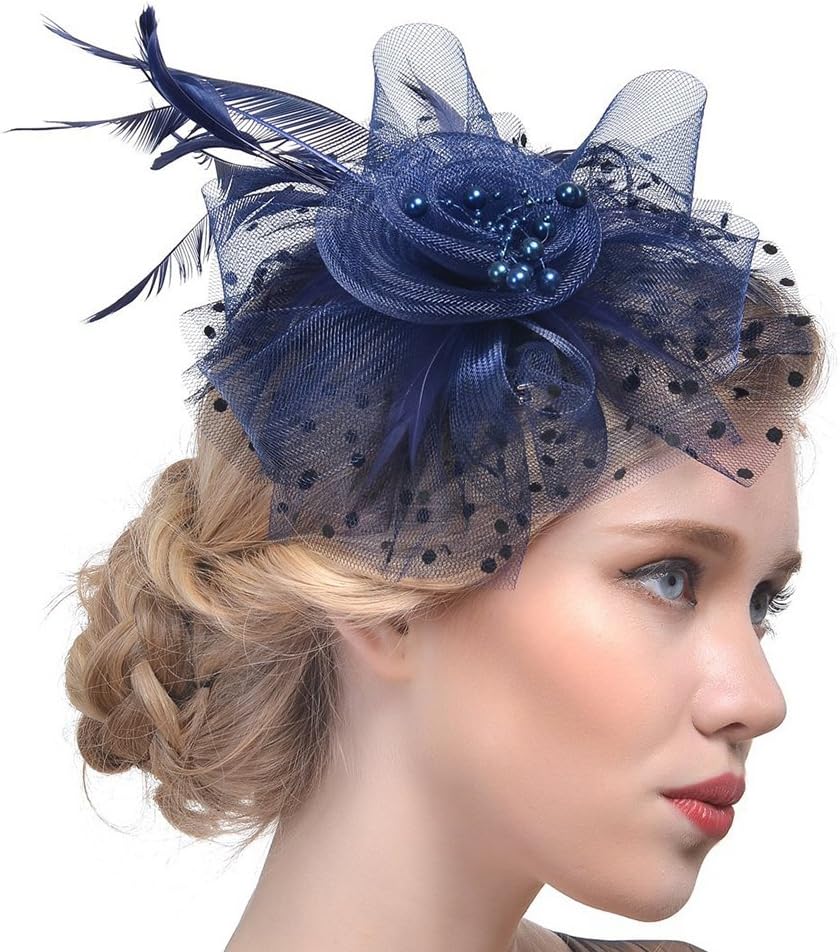
Check price on AmazonNavy is the category’s highest-anxiety color — and the anxiety is justified. Navy fascinators in the budget tier generate a recognizable review pattern: buyers report they feared the piece would arrive looking black based on the listing photo, and express relief when it arrived genuinely navy. That fear embedded in the review text is the data telling you something real. Under incandescent or warm-ambient light, deep navy and black are nearly indistinguishable in a compressed image file. Sinamay pillbox fascinators in navy draw praise specifically for arriving with visible, true navy color — reviewers explicitly call out that the color is “beautiful in person,” language that reads as mild surprise at the accuracy. For navy purchases, buyer-uploaded photos shot in daylight are non-negotiable. If a listing has no buyer photos in natural light, treat it as an unconfirmed color.
DRESHOW
$9.99
In stock on Amazon
Check price on AmazonIvory, blush, champagne, and nude are a family of colors that look similar in listing photos and are meaningfully different in person — and against a white or cream wedding or Derby outfit, the distinction matters enormously. Vogue’s Derby dress code guidance (“The Kentucky Derby Dress Code, Explained,” Vogue.com, 2025 edition) consistently flags that warm ivory and cool white are different enough to clash when placed next to each other. The same logic applies across the warm neutrals: nude skews beige-pink, champagne skews golden, ivory skews warm white, blush skews cool pink-white. Budget listing photography routinely collapses these distinctions because the backgrounds are often white or light gray and the auto-white-balance flattens adjacent colors. Ordering a blush fascinator to match a champagne gown is a genuine risk without buyer photo verification.
DRESHOW
$9.99
In stock on Amazon
Check price on AmazonRed is surprisingly consistent at the budget tier. Saturated, high-chroma colors tend to survive photography better than muted or dark ones because there’s less ambiguity in the hue — the sensor and the screen both know it’s red. The risk with red is less “will it be red” and more “which red” — fire-engine versus wine versus coral. Buyer photo comparison against the specific garment is still useful, but the catastrophic mismatch risk that attaches to navy is largely absent.
DRESHOW
$9.99
In stock on Amazon
Check price on AmazonBy the Numbers: Color Risk at a Glance
| Color | Photography Risk | Primary Failure Mode | Buyer Photo Necessity |
|---|---|---|---|
| Black | Low | Finish variation (matte vs. sheen) | Helpful but optional |
| Navy | High | Reads as black in warm or dim light | Required |
| Ivory / Champagne / Blush | Medium-High | Warm/cool collapse; dye-lot feather variation | Required for outfit matching |
| Red | Low-Medium | Hue subtype (coral vs. wine) | Helpful |
The Dye-Lot Problem Inside the Hat
This is the detail that separates buyers who return one hat from buyers who return three before getting it right. Even when the base color of a fascinator is accurate, the feather trim is often dyed separately — and feathers, particularly ostrich and marabou, accept dye inconsistently. The result is a hat that reads as coherent at arm’s length in a listing photo but shows visible color variance between the woven sinamay base and the feather cluster when you see it in hand.
Harper’s Bazaar’s millinery coverage (“How to Wear a Fascinator,” HarpersBazaar.com) has noted that dye-lot inconsistency is present even at mid-range price points and is not necessarily a quality defect — it’s an inherent property of natural materials being dyed in separate batches. The practical implication for budget Derby shoppers: the risk is higher on any fascinator that combines a woven base with feather or ribbon trim. A solid-construction fascinator — all sinamay, no feathers — has fewer dye interfaces and is more likely to arrive as a single coherent color.
If a listing’s primary photo shows the hat in close-up and you can see that the feathers and base appear to be the same shade, that’s a better sign than a photo that softens the detail. If reviewer photos show slight variation between base and feather, factor that into the decision.
How Much Color Variation Is Acceptable?
The honest answer depends on where the fascinator sits relative to the outfit. A fascinator worn with a monochromatic navy suit needs to match within a narrower range than one worn as a contrast accent to a floral dress. Buyers navigating a close-match situation — where the fascinator color must land within a tight window of the dominant outfit color — account for the majority of multi-return patterns in aggregated feedback for budget light-colored headpieces.
A general working rule: for close-match situations (hat color within the same family as the dominant outfit color), a delta of more than one tone-step is noticeable to the dressed eye in daylight. For contrast accent situations (hat as a pop color against a neutral outfit), you have two to three tone-steps of latitude before the mismatch reads as an error rather than a choice.
Frequently Asked Questions
How do I know if a navy fascinator will look black when it arrives? Check buyer-uploaded photos specifically shot in natural daylight. If all photos show the hat indoors or under warm light, you cannot confirm the color. Look for reviewers who describe verifying the color against a reference garment.
Are reviewer-uploaded photos more reliable than listing photos for color accuracy? Consistently, yes. Buyer photos are unretouched, shot under real-world lighting, and frequently placed next to the outfit they were purchased for. As noted in Who What Wear’s fascinator coverage (“The Best Fascinators for Every Budget,” WhoWhatWear.com, 2025), this is the single most reliable color-verification resource available when shopping online.
What fascinator colors are safest to order online without seeing in person first? Black, then red. Both are high-saturation or neutral colors that survive photographic compression without significant hue shift. Navy and the warm neutrals (ivory, blush, champagne) carry meaningfully higher return risk.
How much color variation between the hat and my outfit is acceptable? For close-match pairings, keep the delta within one tone-step. For contrast pairings, two to three steps is workable. In direct sunlight, mismatches that were invisible indoors will surface.
Can I dye or alter a fascinator if the color is slightly off? Sinamay and parisisal can be over-dyed at home using fiber-reactive dyes, but the results are inconsistent and the process is not reversible. Feathers dye unpredictably. For budget pieces, returning and reordering is almost always the better economic and aesthetic decision. Reserve DIY dye attempts for situations where the hat has sentimental or bespoke value.
Is the color difference between nude, blush, ivory, and champagne significant enough to matter for outfit matching? Yes, meaningfully so. In direct outdoor light — which is exactly where Derby photos are taken — these colors diverge visibly. Ivory is warm white; champagne adds a golden undertone; blush shifts toward cool pink-white; nude reads beige-pink. Against a white gown or a cream-lace overlay, the wrong neutral reads as a mistake rather than a choice. As Vogue’s Derby dress code guidance (“The Kentucky Derby Dress Code, Explained,” Vogue.com, 2025 edition) makes clear, warm and cool whites are distinct enough to clash in daylight. Treat each neutral as a distinct color for purchasing purposes, not interchangeable variations.
The decision rule for all of this is straightforward: if your outfit requires a close color match and the listing has no natural-light buyer photos, treat the purchase as unconfirmed and budget for a possible return. If you’re buying black, or buying as a contrast accent against a neutral, the stakes drop considerably and the listing photo is sufficient. Know which situation you’re in before you add to cart — that single diagnostic saves most of the return friction in this category.