If you’ve ordered a formal church hat or an organza derby topper online and opened the box to find something that looked less like a hat and more like a crumpled decorative cabbage — you are not alone, and you are not stuck. Organza is a sheer, crisp woven fabric (think the stiff, slightly glossy material on bridal veils and formalwear trim) that gives structured church and occasion hats their dramatic silhouette. The problem is that organza is also a fabric with a memory: compress it in a shipping box, and it will hold the shape of that box until you coax it back. That is the core dynamic this guide is about. Whether you’ve just pulled a cloche bowler out of a poly mailer, or you’re advising a client who’s panicking two days before a church anniversary celebration, understanding the difference between a hat that needs five minutes of hand-fluffing and one that needs professional intervention — or a return — will save you real time and money.
This is a practitioner guide. The on-ramp above is for orientation; the rest of this article treats you as someone who already knows the basics and needs a clear decision framework for a hat that is currently sitting on your table looking sorry for itself.
| EDITOR'S PICKFLUFFY SENSE. Big Wide Brim Fed… | Mid-tier2026 Derby Hats for Women Ladies | Budget pickIZUS Women's Derby Sun Hat Bowk… | |
|---|---|---|---|
| Material | Felt | Organza | Organza |
| Brim style | Wide brim | Sun hat | Bowler |
| Embellishment | — | — | Bowknot |
| Size | 6 3/4-7 3/8 | — | Medium |
| Occasion | Nashville | Derby, church | Derby, church |
| Color | Caramel | Black gold | Black |
| Price | $42.99 | $37.99 | $19.99 |
| See on Amazon → | See on Amazon → | See on Amazon → |
What Actually Happens to Organza in Transit
Organza’s stiffness comes from a tight plain weave and, in most entry-to-mid-tier hats, a sizing agent — essentially a starch-like finish applied during manufacturing. That finish is what makes the brim stand at attention and the crown hold its dome. The problem is that sizing agents are somewhat heat- and pressure-sensitive. When a hat gets folded, stacked, or mashed in a box without internal support, the organza creases along the fold lines and the sizing partially collapses in those zones.
This is categorically different from what happens to straw hats in transit, where the damage is usually crushing of the weave itself. With organza, you’re almost always dealing with creasing and deflation rather than structural breakage. That distinction matters enormously for repair: a crushed sinamay brim may have broken fibers that won’t fully recover, but an organza crease is typically a temporary dislocation of the fabric’s memory — one that responds to moisture and gentle reshaping.
Aggregated buyer reviews across multiple structured organza styles show a consistent pattern: a meaningful share of buyers report arrival creasing, and the majority who attempt reshaping report success. The divergence in outcomes — why one buyer of the ORIDOOR organza cloche bowler describes it as “really scrunched up” while another says she “just used her hand to fluff it out and found it gorgeous” — almost certainly reflects variation in packing batches, colorways (darker colors may show pressure marks more visibly), and individual buyer tolerance rather than two different products. The hat is the same; the shipping experience and expectations were not.
Hand-Fluffing vs. Steaming: Know Which Tool the Hat Needs
These are two different interventions, and applying the wrong one wastes time or risks damage.
Hand-fluffing is exactly what it sounds like: using your hands, fingers, and palm pressure to gently push fabric back toward its intended shape. It works best on:
- Light surface creases from box compression
- Deflated organza flowers, rosettes, or bow embellishments
- Crowns that have simply collapsed inward from stacking pressure
The buyer who purchased the IZUS derby hat notes steaming out creases and then specifically fluffing the bow by hand — a two-step approach that reflects good instinct. The bow is a three-dimensional object that steam loosens; the hand then sculpts it back into shape while the fabric is still warm and pliable. That sequence matters: steam first to relax the sizing, hand-shape immediately before it re-sets.
Steaming introduces controlled moisture and heat to relax the sizing agent and the weave. It is the right tool for:
- Deep crease lines that hand pressure alone can’t shift
- Areas where the organza has taken a hard fold
- Crowns or brims that are significantly misshapen rather than merely soft
By the numbers — steaming safety for organza:
- Recommended garment steamer distance: 4–6 inches from fabric surface
- Safe steam duration per section: 5–10 seconds, move continuously
- Re-set time before handling: 30–60 seconds minimum
- Risk threshold: holding steam stationary on organza for 15+ seconds can flatten the weave or leave water spotting
Never use a hot dry iron directly on organza — even with a pressing cloth, the risk of crushing the weave flat or scorching the sizing is too high. A handheld garment steamer or the steam function of a household iron held several inches away is the appropriate tool. Town & Country’s styling guides on occasion dressing have noted that garment steamers are broadly preferable to irons for structured millinery fabrics precisely because they deliver moisture without direct pressure contact.
Reading a Listing for Shipping Quality Before You Buy
This is where practitioners can separate good purchasing decisions from expensive surprises. Most buyers learn the hard way; you don’t have to.
Signals that a hat ships with meaningful protection:
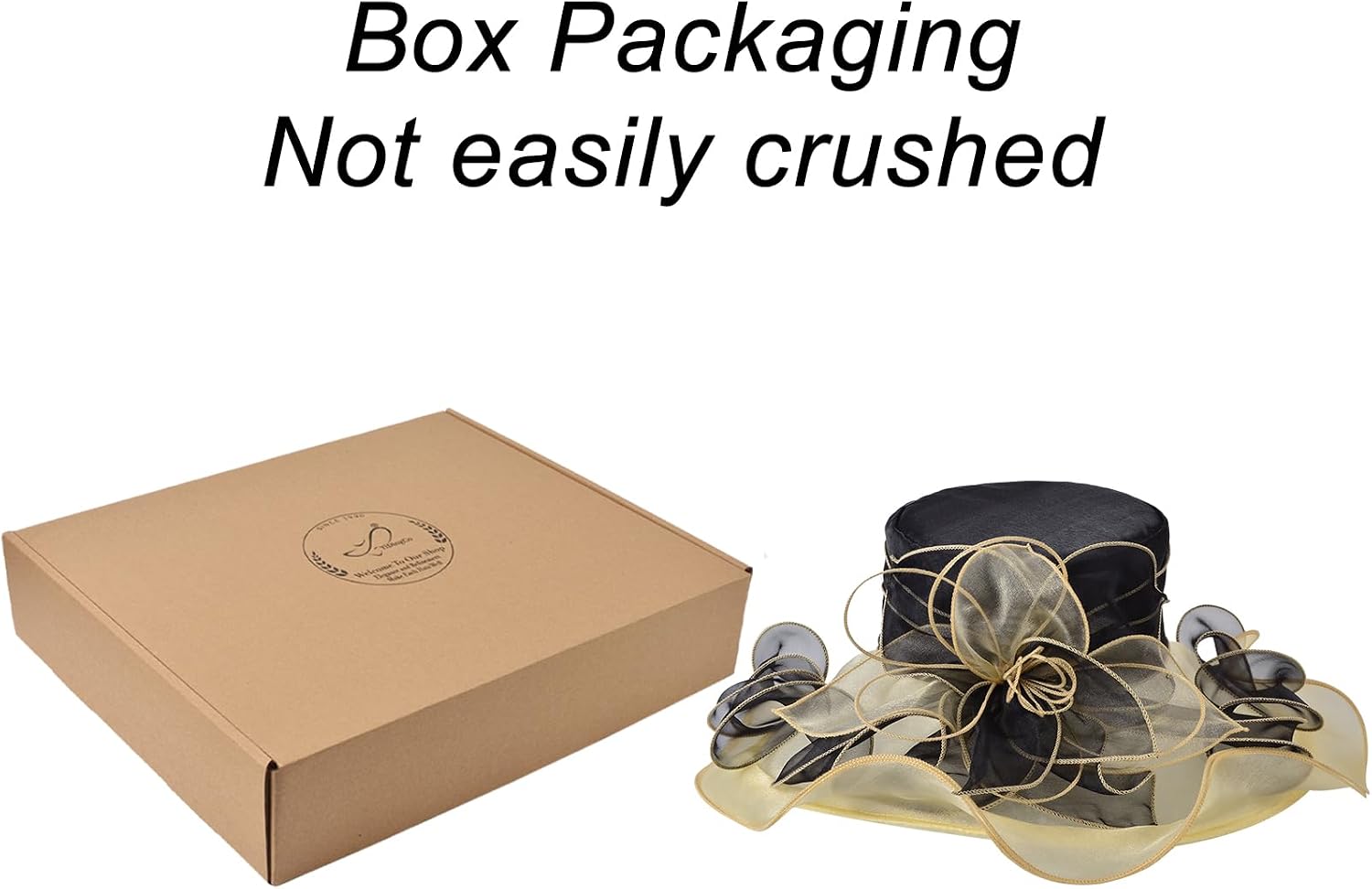
Reviews describing “travels well in the box” or “you can lay anything on top and it will not bend” — language that appeared in buyer feedback for the J-2462 organza derby hat — are among the most useful signals in a listing’s review section. They indicate that the internal box structure (typically a rigid hat form or tissue-stuffed crown) is doing its job. That specific praise is rare enough to be meaningful when you see it.
Look for seller photos that show the hat inside its packaging. Hats shipped in dedicated hat boxes with internal crown stuffing and brim support arrive in dramatically better condition than those folded into generic polybags or flat-packed in envelope mailers. If the listing photos only show the hat on a model or a plain white background with no packaging image, treat that as a mild yellow flag.
Review language to watch for:
| Signal in reviews | What it likely means |
|---|---|
| ”Arrived creased / scrunched” | Standard box pack, no internal support |
| ”Needed steaming” | Expected; hat is fixable but buyer wasn’t warned |
| ”Travels well,” “arrived perfect” | Hat box with internal form likely used |
| ”Returned — couldn’t reshape” | Either severe damage or buyer wasn’t informed on technique |
Harper’s Bazaar’s hat-care coverage consistently emphasizes that proper hat storage (and by extension, shipping) relies on maintaining crown shape from the inside out — a principle that applies directly to what distinguishes a good-faith hat shipment from a careless one.
Acceptable Flaws at the $25–$50 Price Point
This is the conversation that saves practitioners from fielding unnecessary client returns or wasting their own money on expectations the price point cannot support.
At the $25–$50 tier — which covers most structured organza church hats, cloche bowlers, and organza derby pieces sold through mass-market online retail — you are buying a fashion hat, not a millinery investment. Who What Wear’s coverage of accessible church hat style notes that this category serves buyers who want the visual impact of a structured formal hat for a specific occasion, not a piece that needs to hold up across five seasons of wear.
What is acceptable at this price:
- Arrival creasing that responds to hand-fluffing or light steaming
- Minor thread irregularities in organza layering or embellishment attachment
- Bow or flower embellishments that need reshaping on arrival
- Slight variation in colorway saturation from listing photos (screen calibration varies)
- Hat form that is moderately stiff rather than couture-firm
What is not acceptable at any price:
- Fabric tears or snags on arrival
- Embellishment pieces (feathers, flowers, veiling) that are detached or missing
- Structural wire in the brim that is bent beyond reshaping
- Soiling or odor indicating the hat is not new
The DRESHOW bowler buyer who acknowledged fabric flaws and noted she was buying purely for a Derby party and “wasn’t bothered” is making a legitimate practitioner-level call: she correctly mapped her occasion, duration, and budget, and found the value proposition sound for her specific use case. That is not settling — that is knowing what you’re actually buying.
The FLUFFY SENSE fedora, by contrast, earns reviewer praise specifically for its “really sturdy, thick brim” that has “held up well over time” — a construction note that makes it genuinely useful as a contrast reference. When a reviewer volunteers durability language unprompted, that typically indicates a hat whose internal structure (wiring gauge, brim interfacing) exceeds the price-point norm. That is the exception; most organza styles in this tier are occasion-optimized, not longevity-optimized.
Frequently Asked Questions
Is it normal for an organza hat to arrive creased?
Yes — significantly more common than not at mass-market price points. The majority of organza church and derby hats shipped through standard retail fulfillment are not packed with internal crown support. Arrival creasing is the expected starting condition, not an indicator of a defective hat. Knowing this before you order changes the experience from a surprise to a minor task.
Can I steam an organza hat at home without damaging it?
Yes, with the right tool and technique. A handheld garment steamer held 4–6 inches from the fabric surface is the safest approach. Move the steamer continuously — never hold it stationary on one spot. Allow each section to cool and re-set before handling. Do not use a dry iron in direct contact with organza.
What is the difference between hand-fluffing and steaming for formal hat reshaping?
Hand-fluffing uses manual pressure to restore shape to areas that have softened or compressed without a hard crease — it works on deflated bows, rosettes, and lightly collapsed crowns. Steaming relaxes the fabric’s sizing agent so that deep crease lines can be smoothed and the hat can be reshaped while warm. For most arrival issues, you’ll use both in sequence: steam the affected area, then hand-shape immediately while the fabric is still pliable.
How do I know from a listing whether a hat ships in a proper hat box?
Look for packaging images in the listing photos. Read reviews for language like “arrived perfectly shaped,” “travels well,” or explicit mentions of a hat box or form insert. Absence of any reviewer commentary on arrival condition — positive or negative — is a weak signal; reviews that specifically praise arrival condition are a strong positive indicator.
Should I return a creased formal hat or try to reshape it first?
Try reshaping first unless the hat has physical damage (tears, bent structural wire, missing embellishments). Arrival creasing in organza is almost always reversible with hand-fluffing and/or steaming. Initiating a return before attempting reshaping is the most common mistake buyers make — and most sellers’ return windows are long enough that you have time to try the repair first. If reshaping fails, the hat still qualifies for return on arrival-condition grounds.
What flaws are acceptable at the $25–$50 church hat price point?
Reshapeable creasing, minor thread irregularities, embellishments that need light hand-fluffing, and moderate (not couture) stiffness are all within the normal range for this tier. These hats are occasion-optimized. Vogue’s hat-care guidance distinguishes between fashion hats built for a season and investment millinery built for provenance and longevity — understanding which category you’re in prevents misaligned expectations on both sides of the transaction.
If X, then Y — your decision rule:
- If the hat arrived creased but has no physical damage → attempt hand-fluffing and steaming before anything else; success rate among documented buyer accounts is high.
- If the hat has a detached embellishment, torn fabric, or bent structural wire → photograph it and initiate a return immediately; these are not reshaping problems.
- If you’re buying for a one-time occasion at $25–$50 → minor construction irregularities are an acceptable tradeoff for price; calibrate expectations to the tier.
- If you’re sourcing for a client with a high-visibility occasion → prioritize listings with explicit positive arrival reviews and visible hat-box packaging; pay the premium for the J-tier shipping experience, not just the hat itself.
- If you want a structured hat that reviewers have specifically praised for durability over time → weight construction language (“sturdy brim,” “held up well”) above style imagery; that language is rare and meaningful when it appears.