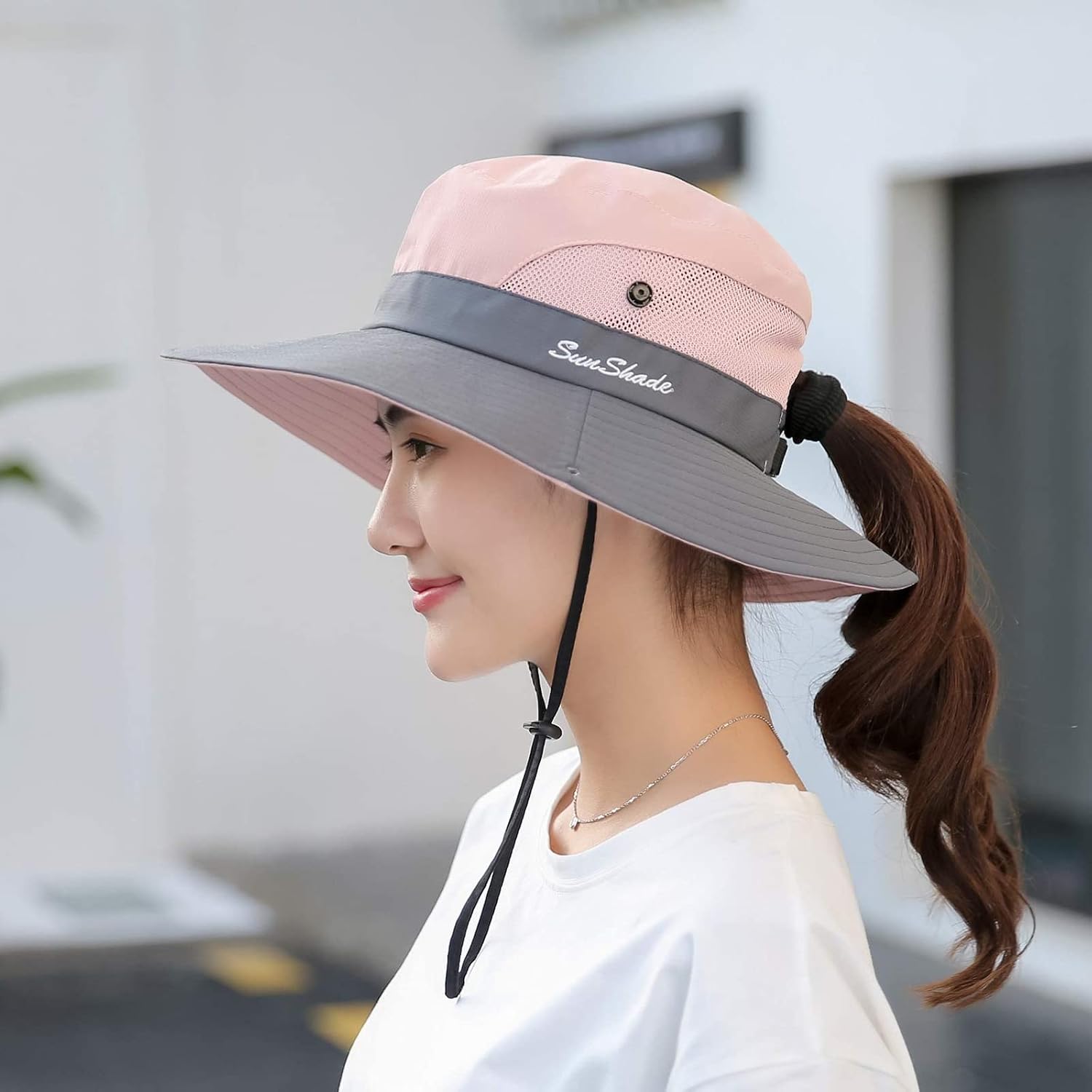
If you’ve ever shown up to a hiking trail, outdoor farmers market, or long afternoon of yard work only to realize your hat is either sitting at home or completely useless because you can’t get your ponytail through it — this guide is for you. Activity hats (also called sun hats, outdoor hats, or UPF hats — UPF stands for Ultraviolet Protection Factor, the fabric equivalent of SPF for your skin) have evolved well past the floppy straw hat of decades past. Today’s best options are lightweight, packable, wind-resistant, and designed specifically to accommodate a ponytail or bun through a back opening or adjustable slot. If you’re already shopping this category and trying to choose between a ponytail baseball-style cap, a bucket hat with ventilation, or a wide-brim safari hat, this guide maps out exactly where each style wins, where it compromises, and what the real-world tradeoffs look like.
| EDITOR'S PICKLeotruny Women Super Wide Brim… | Mid-tierFURTALK Womens Wide Brim Sun Ha… | Budget pickZOORON Women's Ponytail Safari… | |
|---|---|---|---|
| Ponytail opening | — | — | ✓ |
| UPF rating | UPF50+ | UPF | — |
| Waterproof | ✓ | — | — |
| Wind lanyard | — | ✓ | — |
| Size | One size | Medium-Large | 6 3/4-6 7/8 |
| Price | $24.99 | $23.39 | $9.98 |
| See on Amazon → | See on Amazon → | See on Amazon → |
The Four Hat Types Worth Knowing — and When Each One Makes Sense
Before diving into specific products, it helps to have a clear mental framework. The outdoor activity hat market in 2026 has consolidated around four main silhouettes for women, each with a different primary strength.
Ponytail slot caps — structured or semi-structured caps with a gap or elastic opening at the back — are the workhorse of this category. They’re the most secure option during vigorous activity and the easiest to wear in and out of a car. The ZOORON ponytail hat has become a reference point in this silhouette: owners consistently praise the ponytail-slot design paired with a small cinch adjuster at the back, and a notable pattern in reviews is that buyers keep one in their car for spontaneous outdoor errands or walks. That’s a meaningful signal — it’s the kind of hat you actually reach for.
Bucket hats with ventilation — soft, packable hats with a downward-sloping brim all the way around — offer 360-degree shade with more airflow than a solid-fabric wide-brim. The FURTALK ponytail bucket hat specifically draws repeat praise for its air vents and lightweight fabric. Reviewers who switched from straw bucket hats cite a specific complaint about their old hats: straw traps heat against your head. The FURTALK version’s synthetic or blended fabric + vent construction keeps air moving in a way straw can’t replicate.
Wide-brim sun hats (3”–5” brims) — the classic big-brim option that maximizes facial and neck coverage. These offer the most square inches of UV protection per dollar, but they come with real fit and proportion caveats (more on that below). The Leotruny super-wide-brim is in this category.
Neck-flap safari hats — structured or semi-structured hats with a fabric panel that drops from the back brim to protect the nape of your neck. The FURTALK neck-flap safari hat earned a memorable review from a self-described fair-skinned bald man who noted the flap protected his neck without hitting car headrests when he leaned back — a practical detail almost no other review captures. For women with fine or thinning hair, or anyone who burns on the back of the neck first, this detail is worth taking seriously.
The Fit Warning No One Tells Petite Shoppers
This is the part of wide-brim hat buying that product pages consistently undersell, and it’s where real shoppers have been burned.
A reviewer of the Leotruny super-wide-brim hat explicitly noted that the brim was proportionally too large for her 5’2” frame and she returned it. That’s a specific, actionable data point — not a vague complaint about sizing. Here’s what’s happening structurally: a 4”–5” brim that looks proportional on a 5’7” model photograph will extend significantly past the shoulder line of a petite frame, creating a silhouette that reads costumey rather than chic, and can actually obscure your peripheral vision.
The decision rule for wide-brim shopping if you’re under 5’4”:
- A 3”–3.5” brim is generally proportional for petite frames
- A 4” brim is a try-before-you-buy situation — fine in many cases but worth confirming in person or with a generous return window
- A 5”+ brim on a petite frame requires a deliberate style commitment; it can work for a still moment (garden party, beach lounging) but is awkward during activity
Per Wirecutter’s coverage of sun hats, brim width directly correlates with UV coverage — but they also note that wearability is the real variable, because a hat you take off is providing zero protection. The hat you’ll actually keep on your head is the better investment.
Wind Resistance: The Unspoken Buying Criteria
Scan the reviews across virtually every product in this category and one theme surfaces repeatedly: buyers have been burned by hats that blow off. Wind resistance — via chin straps, interior drawstrings, or cinch cords — is mentioned in nearly every active-use review, making it effectively a baseline expectation rather than a bonus feature.
By the Numbers:
- 3”+ brim = meaningful wind catch; chin strap or cord becomes important above light breeze
- Bucket hat silhouette = lower wind profile than wide-brim, less chin strap dependency
- Ponytail cap silhouette = lowest wind profile; fitted crown + ponytail weight anchors the hat naturally
- Neck-flap safari hats = flap adds drag; chin strap is near-essential for hiking or beach use
If you’re buying for an activity where you’ll be moving fast (hiking, cycling, paddleboarding, outdoor sports), a ponytail cap or fitted bucket hat with a drawstring is a more honest choice than a wide-brim that requires constant adjustment. If you’re buying for relatively still outdoor time (gardening, beach lounging, outdoor dining), a wide-brim without a chin strap is workable.
Elle’s roundup of best women’s activity hats flags chin straps as the dividing line between “fashion sun hat” and “working sun hat” — the distinction matters when you’re actually moving.
UPF Claims: What the Numbers Mean in Practice
UPF 50 is the standard claim you’ll see across fabric bucket hats and sun hats in this category. Here’s what that means and, more importantly, what it doesn’t mean.
What UPF 50 means: The fabric blocks approximately 98% of UV radiation passing through the material itself. The Skin Cancer Foundation notes that UPF 50 fabric is their threshold for “excellent” protection. For covered skin under the hat’s brim and crown, this is meaningful and real.
What UPF 50 doesn’t cover: The rating applies to the fabric, not your full exposure. UV bounces — off sand, water, pavement, and snow — and can reach skin from below the brim. A wide-brim hat helps more here than a narrow brim, but no hat alone is a complete sun strategy. Refinery29’s guide to wide-brim sun hats notes that dermatologists recommend pairing any hat with sunscreen on the face, neck, and décolletage regardless of UPF rating.
The practical verdict for a full day outdoors: Yes, a UPF 50 fabric bucket hat provides meaningfully better protection than a loose-weave straw hat or a baseball cap, both of which can have effective UPF ratings as low as 5–10 depending on weave density. Buyers who switched from straw to the FURTALK bucket hat specifically call out that their scalp and part line stopped burning — that tracks with the material science. But supplement with sunscreen on any exposed skin, especially the face.
Packability: Can These Actually Fit in a Gym Bag or Carry-On?
This is a real consideration for buyers who want one hat that travels well. Here’s the honest breakdown by silhouette:
Ponytail slot caps: Structured caps with a sewn brim don’t pack flat. They can be stuffed into a bag but will hold a crease. Best treated as a grab-and-go hat that rides in a car cupholder or sits on a dashboard, not one that goes in a suitcase.
Bucket hats (fabric): Genuinely packable. The FURTALK ponytail bucket hat, like most soft bucket hats, rolls or folds into a small pouch-sized shape and recovers well. This is the most packable silhouette in the category.
Wide-brim fabric sun hats: Packability depends entirely on construction. Soft, unstructured wide-brims roll into a carry-on without issue. Hats with wire-reinforced brims (for maintaining shape) don’t pack flat and need their own space. Check whether the brim has a wire before assuming it’s packable.
Neck-flap safari hats: The structured crown doesn’t compress well, but the flap folds flat. These travel reasonably in a tote bag but not in a stuffed suitcase without a hat form or box.
Frequently Asked Questions
Will a ponytail hole hat stay on during vigorous activity or wind? Generally yes — more reliably than a wide-brim without a strap. The ponytail itself acts as a natural anchor by threading through the back opening, and a rear cinch adjuster (as on the ZOORON) lets you dial the fit snug. For very high-movement activity or sustained wind, a chin cord is a meaningful addition. Buyers who report hats blowing off are almost always describing wide-brim hats, not fitted ponytail caps.
Is a neck-flap hat cooler or hotter than a wide-brim straw hat? Counterintuitively, a fabric neck-flap hat with ventilation panels can be cooler in direct sun than a straw wide-brim — straw traps heat against the crown and can create a small greenhouse effect, while ventilated fabric allows air to move through. The trade-off is that straw’s open weave lets some breeze through from every angle. The FURTALK neck-flap hat’s airflow gets positive marks in reviews, particularly from buyers coming from solid straw options.
How do I know if a wide brim will be proportionally too large for my height and frame? A useful shorthand: your hat’s brim should not extend noticeably past your shoulder width when viewed from the front. For most petite frames (under 5’4”), this means looking for brims in the 3”–3.5” range. If product photos show a model of a clearly different build than yours, look for review photos from buyers who mention their height. The Leotruny super-wide-brim return story is worth taking seriously: size up with return flexibility.
Can these hats be packed flat in a carry-on or gym bag? Soft bucket hats, yes — reliably. Structured ponytail caps and safari-style hats, no. Wide-brim hats depend on whether the brim has wire reinforcement; check before buying if packability matters to you.
Are the UPF claims on fabric bucket hats actually meaningful for a full day outdoors? Yes, for covered skin — UPF 50 blocks roughly 98% of UV through the fabric itself, which is the Skin Cancer Foundation’s benchmark for excellent protection. The limitation is reflected UV from ground surfaces, which reaches skin from below the brim. A wider brim helps more than a narrow one, but no hat replaces sunscreen on exposed facial skin. Buyers who’ve dealt with scalp burning report real improvement after switching to UPF-rated fabric hats from unrated straw.
The Decision Framework: If X, Then Y
If your primary use is vigorous movement (trail running, cycling, outdoor sports): ponytail slot cap with a cinch adjuster. Lowest wind catch, best security, easiest to wear in and out of a car.
If your primary use is sustained outdoor exposure (beach, garden, long walks): UPF fabric bucket hat with vents. Best packability, genuinely cooler than solid straw, the honest workhorse pick.
If neck and scalp protection are your top priority: neck-flap safari hat. The flap coverage matters if you burn at the nape or have thinning hair, and reviewers who buy for this reason are consistently satisfied.
If you want maximum facial shade and your frame is 5’5”+: wide-brim sun hat (3.5”–4” brim). If you’re under 5’4”, stay at 3”–3.5” and buy with a return option.
If the hat needs to fly with you or live in a gym bag: soft bucket hat, no wire brim, full stop.
The best active hat is the one you actually keep on your head. Everything else is secondary.