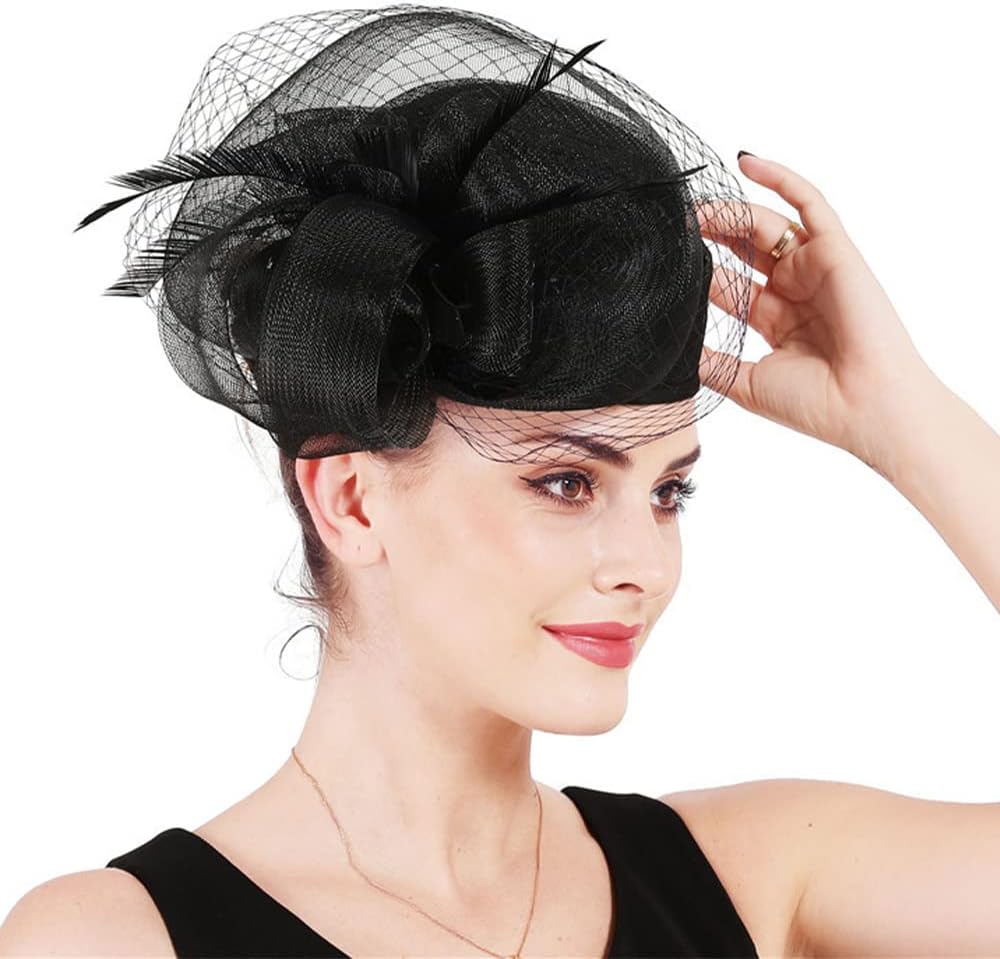
If you’ve ever looked at a hat rack at a Derby party and wondered what that sculptural, feathered little headpiece perched behind one ear is actually made of — you’re not alone. That piece is almost certainly a fascinator (a small, decorative headpiece attached to the hair with a clip or comb, rather than sitting over the head like a full hat), and the stiff, mesh-like woven material it’s built from is almost certainly sinamay (pronounced SIN-uh-may). Sinamay is a fabric woven from the stalk fibers of the abacá plant, a relative of the banana plant grown mainly in the Philippines. It’s lightweight, holds its shape beautifully when stiffened and blocked, and takes dye in rich, even tones — which is why it dominates the fascinator world from $45 drugstore clips all the way up to $600 custom millinery commissions. This guide explains how sinamay is made, why quality varies so dramatically across that price range, and gives you a clear decision framework for sourcing or buying at any level.
| EDITOR'S PICKFADVES Fascinators Pillbox Hat… | Mid-tierZ&X Sinamay Fascinator Hat Flor… | Budget pickORIDOOR Sinamay Flower Feathers… | |
|---|---|---|---|
| Style | Pillbox / fedora | Pillbox | Pillbox |
| Embellishment | — | Floral + feather | Flower + feathers |
| Attachment | — | Headband + clip | Headband |
| Size | Large | — | One size |
| Color | Black | Red | Light blue |
| Price | $40.99 | $31.99 | $18.99 |
| See on Amazon → | See on Amazon → | See on Amazon → |
How Sinamay Is Made — and Why That Process Determines Everything Downstream
Understanding the production chain isn’t academic here. It directly explains why two sinamay fascinators can look similar on a product page and perform completely differently on a person’s head at noon in a Louisville infield.
Abacá fiber is harvested from the leaf stalks of the plant, then stripped, dried, and woven into open-mesh fabric. The resulting base material is flexible and relatively soft — not the crisp, architectural shape you see on a finished fascinator. That stiffness comes from a separate finishing step: the raw fabric is treated with a starch or resin solution, then blocked (stretched over a three-dimensional mold called a block and allowed to dry under heat or at room temperature) to hold a specific sculptural form.
As Smithsonian Magazine’s overview of millinery craft notes, blocking is where the maker’s skill becomes the decisive variable. A correctly blocked piece will hold its curl, roll, or peak across an entire race day. An under-blocked piece softens in humidity. An over-stiffened piece cracks or flakes at fold points. None of those failure modes are visible at purchase — they reveal themselves in use.
Weave count matters, too. Sinamay comes in several grades defined partly by how tightly the fibers are woven. Open-weave sinamay is sheer and light — flattering in layered, petal-shaped constructions but structurally dependent on stiffening because there isn’t much fiber density to hold shape on its own. Tighter-weave sinamay (sometimes labeled “double sinamay” or “stiffened sinamay fabric” by millinery suppliers) has more body before finishing and produces stiffer, more durable finished pieces. When milliners describe a fascinator as having “good hand,” they usually mean the fabric density and blocking work together well — the piece is resilient without feeling plasticky.
The Price Ladder: What You Actually Get at Each Tier
Here’s where the practitioner decision-making lives. You’re likely sourcing for a client, curating your own occasion wardrobe, or evaluating a Derby or bridal commission — so let’s map the tiers honestly.
By the Numbers
| Price Range | Construction Reality | Typical Lifespan |
|---|---|---|
| $28–$80 | Machine-cut sinamay, pre-stiffened, heat-set on standard molds | 1–2 wears before shape softens |
| $100–$200 | Hand-finished edges, better dye lot consistency, comb vs. basic clip | 3–5 wears with care |
| $250–$450 | Hand-blocked on custom or semi-custom molds, milliner-finished | 5–10+ wears; restorable |
| $500+ | Bespoke blocking, couture trims, provenance | Indefinite with proper storage |
$28–$80 (Entry tier): These are almost exclusively factory-produced pieces. The sinamay is cut from pre-stiffened flat sheets rather than individually blocked over a dimensional form. The result is a piece that looks correct in photographs and holds up for a single occasion — which is genuinely fine if you’re attending one Derby party and don’t expect to wear it again. Vogue’s Royal Ascot preview coverage has pointed out that even at this tier, the color payoff from sinamay’s dye absorption is legitimately good; the construction shortcut is in shape retention, not color.
$100–$250 (Mid-tier): This is where hand-finishing enters. Edges on mass-produced sinamay are typically heat-sealed (the fibers are melted together, creating a slightly plasticky ridge). At this tier, you start seeing hand-rolled or hand-sewn edges — the fibers are folded back and stitched, which produces a softer, more organic-looking finish that reads as clearly more refined at conversational distance. Brands in this range, including Eric Javits occasional headpieces and the millinery offerings from Lack of Color’s occasion line, typically use better dye-lot control and improved comb or barrette hardware.
$250–$500 (Designer-adjacent and independent milliners): Hand-blocking on dimensional molds is the standard at this tier, and it’s not a minor upgrade. As Harper’s Bazaar has noted in fascinator buying guides, a hand-blocked piece conforms to a specific sculptural intention — the maker chose a particular crown height, brim roll, or petal depth and built toward it, rather than cutting a shape from a pre-stiffened sheet. The difference is visible in the evenness of the curve and the consistency of the stiffness across the piece. Independent milliners — Gladys Tamez, local hat artists working in cities like Nashville, New Orleans, and Charleston — often operate in this range for semi-custom work, and the traceability of the piece (you can know exactly who blocked it and on what) has real value for clients who care about provenance.
$500+ (Couture and bespoke): At Philip Treacy or Maison Michel levels, the sinamay itself may be custom-dyed to a client’s exact gown swatch. Blocking is on proprietary molds. Trims — feathers, silk flowers, veiling — are sourced from specialist suppliers and hand-applied. Elle’s overview of race day headwear has described these pieces as “sculpture for the head,” and that framing is accurate: the design process for a bespoke piece at this tier can involve multiple fittings and silhouette consultations. The sinamay is often combined with other materials — parisisal (a finer, smoother woven fiber), fur felt, or sinamay laminated over buckram — to achieve structural goals that single-material construction can’t hit.
Occasion-Specific Buying Decisions: Derby, Bridal, and Beyond
Kentucky Derby and Race Days
Town & Country Magazine’s Kentucky Derby hat coverage consistently emphasizes one decision variable above material: proportion relative to the wearer’s face and frame. A sinamay fascinator is not the only correct choice for the Derby (a wide-brim felt or straw hat is equally traditional), but it is the dominant choice for wearers who prioritize ease of movement, photography-friendliness, and the ability to actually see the race.
The tradeoff: fascinators are more sensitive to precise placement and secure attachment than full hats. A comb that isn’t well-anchored in the hair will shift over a four-hour outdoor event. When sourcing or buying for Derby specifically, prioritize fascinators with dual attachment — both a comb and a secondary clip or elastic loop — over clip-only pieces. This is a construction detail that separates mid-tier from entry pieces at a functional level that matters.
Bridal
In bridal contexts, sinamay fascinators compete primarily with silk flower clips, fresh florals, and veiled headbands. Sinamay wins on structure and photographic presence — the material catches light in a way that flat fabric or fresh florals don’t, and it holds a silhouette across a twelve-hour wedding day that fresh flowers simply cannot.
The relevant craft consideration for bridal: dye stability. A white or ivory sinamay fascinator should be pressed from the same dye lot as any other sinamay elements in the look (a bag trim, a belt detail). Off-lot whites in sinamay are noticeably different under the warm light typical of wedding venues. This is worth raising explicitly with any milliner taking a bridal commission.
Church Hat Tradition
In communities where elaborate Sunday hats carry significant cultural and religious meaning — a tradition with deep roots in African American church culture — sinamay fascinators often serve a different function than in race-day or bridal contexts. As the Smithsonian’s millinery craft documentation notes, the hand-blocking and trim intensity that characterize high-end sinamay pieces align naturally with the aesthetic values of the church hat tradition, where the hat’s visibility and impressiveness are part of its social and spiritual meaning. At this intersection, bespoke construction at the $300–$600 range is often the appropriate starting point, not an upmarket option.
The Decision Framework: If X, Then Y
Here’s the plain-language rule set for anyone sourcing or buying sinamay fascinators with a real occasion on the calendar:
If you need a single-wear piece for a mid-stakes occasion (a friend’s Derby party, a garden wedding as a guest): Entry to mid-tier ($45–$150) is defensible. Focus your evaluation criteria on color accuracy relative to your outfit and attachment hardware quality, not construction depth you won’t recoup in reuse.
If you’re styling a client for a high-profile occasion or buying for your own wardrobe across multiple seasons: Mid-to-designer tier ($200–$450) makes the math work. A hand-blocked piece from an independent milliner will survive 5–8 wears with correct storage (stuffed with tissue, in a hatbox, away from humidity) and can be re-trimmed between seasons. The per-wear cost typically beats entry-tier rebuying.
If you’re commissioning for bridal, bespoke race-day, or church occasions where the headpiece is a centerpiece of the look: Bespoke from a named milliner at $450+ is the correct tier — not because the material is categorically different, but because fit consultation, dye-lot matching, and the ability to revise before delivery are services that protect the investment and eliminate the most expensive failure modes (wrong proportion, color mismatch, insecure attachment on an important day).
If you’re evaluating a mid-tier piece and can’t determine whether it’s hand-blocked: Turn it over and look at the interior. Machine-cut sinamay from flat sheets typically shows a uniform stiffness throughout. Hand-blocked pieces usually show slight variation in tension — a bit more body at the apex of a curve, slightly less at the edges — because the material was shaped under compression over a form. It’s not a perfect test, but it’s the one you can do at a trunk show or in a boutique without a technical background. Harper’s Bazaar’s fascinator buying guidance suggests the same tactile check as a quick proxy for construction quality.
The sinamay fascinator market rewards exactly this kind of informed evaluation. The material itself is democratic — grown from a plant, woven in relatively accessible quantities, available at every tier. What differentiates a $60 piece from a $600 one isn’t a secret ingredient. It’s skill, time, and intention applied at the blocking table. Knowing that is what turns a purchase into a decision.