If you’ve been scrolling western hat content and wondering whether you actually need to spend real money or whether a $30 straw cowboy hat will get the job done — this is the article you want. A straw cowboy hat is exactly what it sounds like: a hat with the classic high, pinched crown and wide brim of the American West, constructed from woven straw rather than felt. The best straw versions come with what sellers call a “shapeable brim” — meaning a flexible wire runs through the outer edge so you can bend it up on the sides, sweep it down in front, or angle it asymmetrically without the hat springing back flat. That single feature separates a hat you can actually style from one that just sits on your head looking generic. This guide maps the budget tiers honestly, names the fit quirks you’ll hit in the market right now, and closes with a decision framework for every use case from beach day to country music festival to summer wedding.
| EDITOR'S PICKWQWOVRVO Cowboy Hat | Mid-tierFoeran Men's Women's Straw Cowb… | Budget pickBESOOGII Straw Sun Beach Cowboy… | |
|---|---|---|---|
| Brim type | Shapeable | — | Short brim |
| Bands included | — | 2 | — |
| Size | — | One size | One size |
| Colors offered | 3 | — | — |
| Style | — | Western | Western |
| Price | $35.99 | $35.88 | $28.99 |
| See on Amazon → | See on Amazon → | See on Amazon → |
What Budget Actually Buys at Each Tier
The straw cowboy hat market sorts into three honest bands. Understanding what changes at each price point — and what stays the same — is the most efficient way to avoid a purchase you’ll regret.
Entry Tier: $20–$50
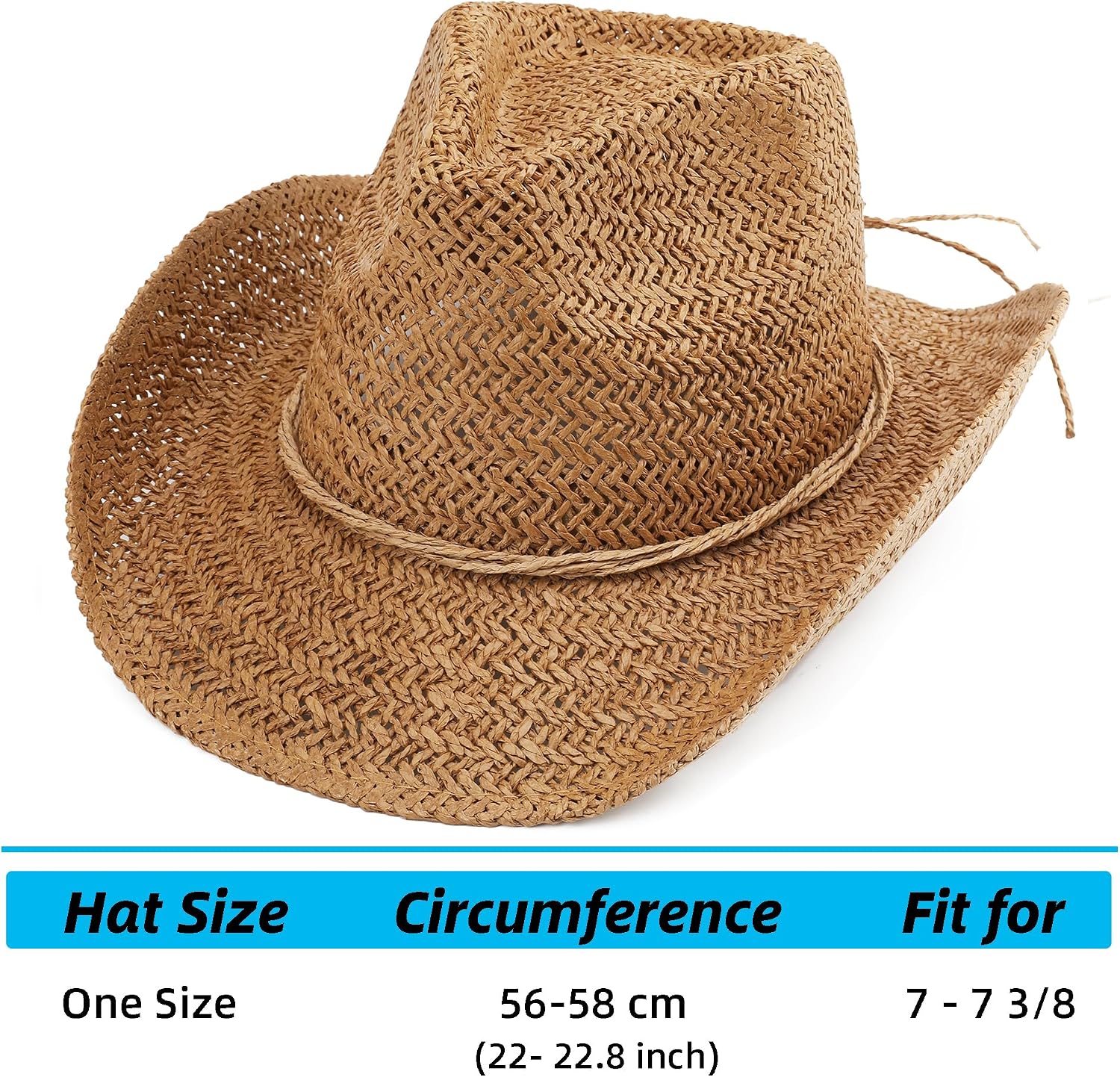
BESOOGII
$28.99
In stock on Amazon
Check price on AmazonAt this tier you’re getting paper straw or thin natural straw woven over a lightweight plastic crown form. The crown form is the internal skeleton that holds the hat’s shape — it matters more than most buyers realize. The form adds interior volume to the crown that eats into the listed circumference, which is why reviewers across multiple entry-tier listings consistently flag that these hats run small. That’s not a size-chart error; it’s a mechanical consequence of the construction. Budget another half-inch mentally when reading size specs here.
Brim wire at this level, when it exists at all, is light gauge — enough to hold a casual curl for a few hours but not through a full festival day in humidity. Hatbands and hardware are functional rather than considered. This tier is the right starting point for a first-time straw cowboy hat buyer who isn’t sure the silhouette will suit her and doesn’t want to commit serious money while she finds out.
Best use: Day festivals, beach, casual summer wear, costume and theme events.
BESOOGII
$28.99
In stock on Amazon
Check price on AmazonMid Tier: $55–$120
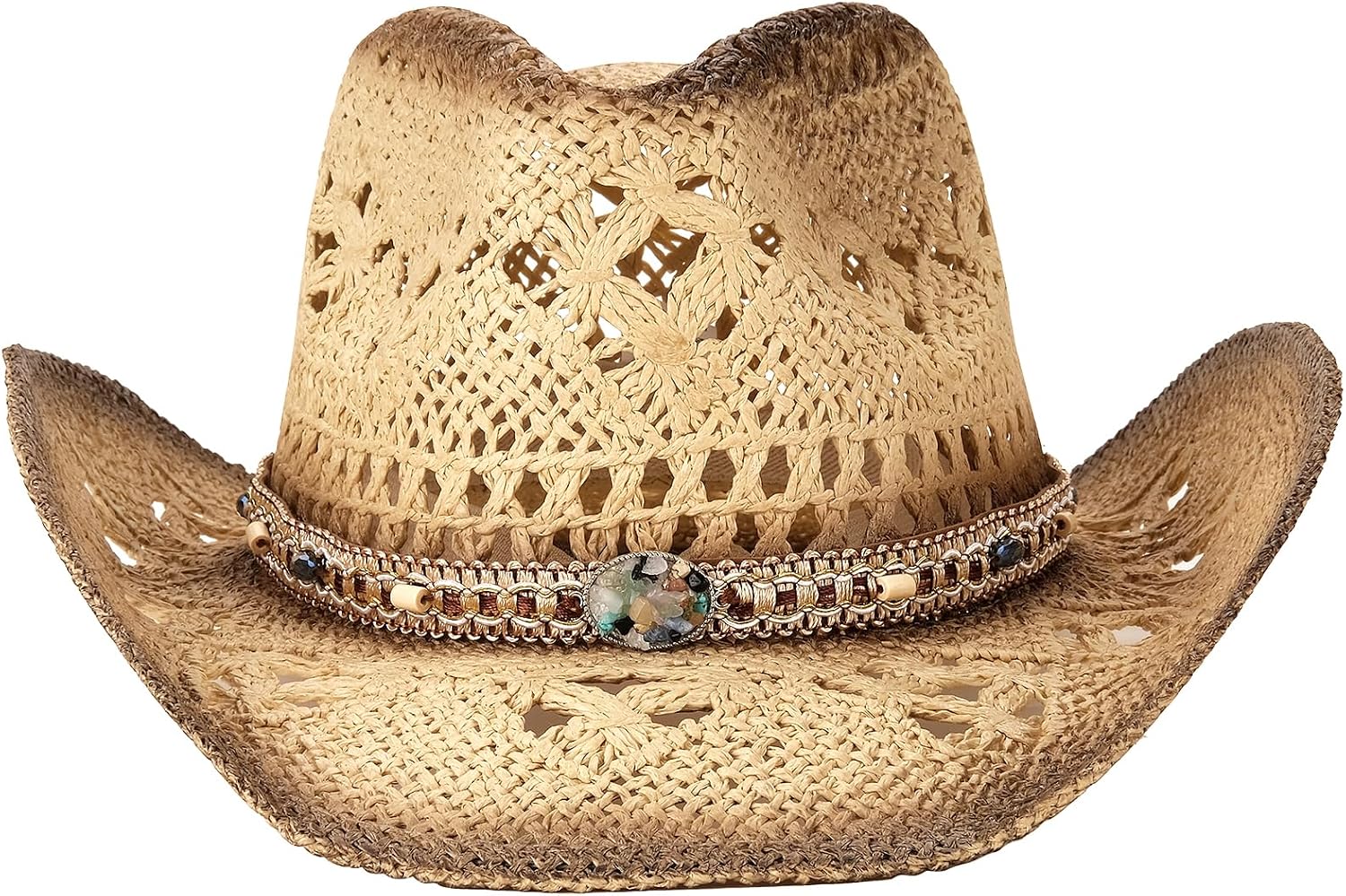
Foeran
$35.88
In stock on Amazon
Check price on AmazonNatural seagrass, paper-wrapped wire, or low-grade toyo straw — toyo is a smooth, slightly shiny woven paper fiber, not plant-based, but it presses cleanly and holds a crease — define this band. Shapeable brims become standard rather than a listed feature upgrade. Brim wire is heavier gauge, which means a bend you set at the festival stays set for the duration of the festival. Hardware — hatbands, buckles, chin cords — starts looking intentional rather than thrown on.
The Foeran straw cowboy hat is a strong example of what this tier can deliver: buyers note that packaging quality and included accessories (hatband extras, sizing foam inserts) make the purchase feel considered, and the brim wire is consistent enough to hold a moderate curl through a full day’s wear. Elle’s western hat coverage (“Western Style Is Back and These Are the Hats Leading the Charge”) has noted mid-tier woven hats as the sweet spot for buyers who want western styling to integrate with real wardrobe use rather than function as a novelty purchase.
Best use: Concerts, outdoor weddings, travel, multi-day wear.
Foeran
$35.88
In stock on Amazon
Check price on AmazonPremium Tier: $130–$300+
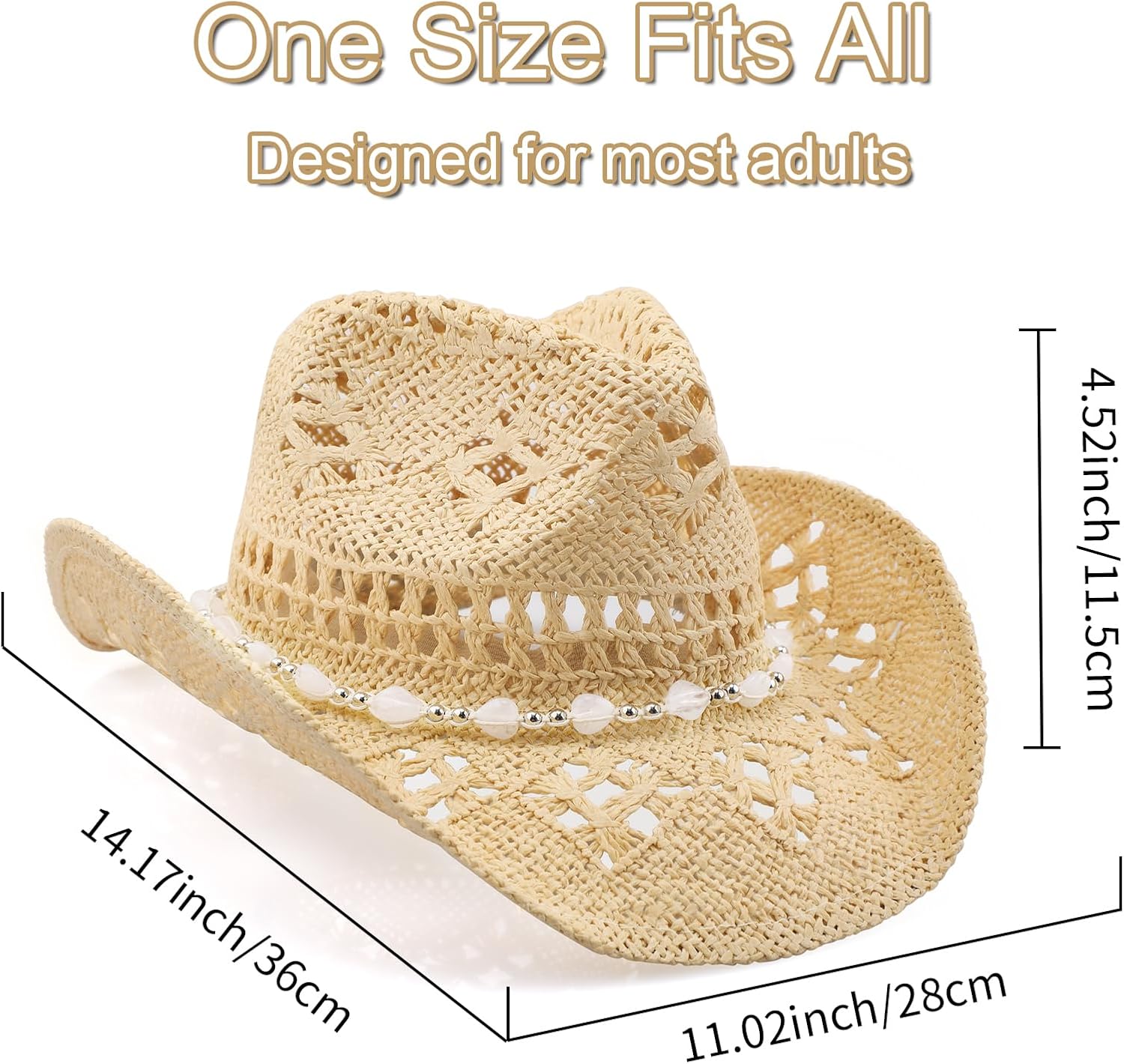
WQWOVRVO
$35.99
In stock on Amazon
Check price on AmazonNatural parisisal (a fine plant-fiber weave from Mexico and Ecuador), quality toyo with a lacquered finish, or genuine palm straw characterize this range. These hats have enough structural integrity to be blocked — shaped over a wooden form with steam — which produces cleaner crown lines and brim geometry than the plastic-form construction below them. Brands operating here include Eric Javits and Lack of Color, whose wide-brim western silhouettes Who What Wear (“The Best Cowboy Hats for Women Right Now”) has cited as the entry point for serious wardrobe investment in western headwear.
The premium tier earns its price in three concrete ways: brim control that holds through weather, materials that read intentional rather than costume-adjacent at close range, and construction that tolerates repeated wear without the straw splitting or the crown losing its shape. For a race day, an elevated outdoor occasion, or a styled event where the hat silhouette is load-bearing in the look, this is the tier that delivers.
Best use: Race days, western-themed weddings, elevated outdoor occasions, investment pieces.
WQWOVRVO
$35.99
In stock on Amazon
Check price on AmazonFit Is the Issue Nobody Warns You About
Here’s the pattern you’ll see repeated in review clusters for the most popular entry-tier straw cowboy hats: buyers order their usual hat size — say, a 57cm (Medium) — and the hat fits tightly or won’t seat fully on the head. The explanation is mechanical. The plastic crown form that provides the hat’s shape occupies interior space. The circumference printed on the size chart often reflects the form’s outer measurement, not the wearable inner circumference. Elle’s western hat coverage has noted this as a recurring friction point with mass-market woven hats in general.
What to do about it:
- If the listing uses S/M/L rather than centimeters, assume it runs one step small and order up.
- If centimeter measurements are given, measure your own head at the widest point (just above the ears, across the forehead) and add 1–1.5cm before matching to the chart.
- For plastic-form crown constructions specifically, the “order a size up” note appears with enough frequency across buyer reviews to treat it as a reliable correction, not an outlier complaint.
Buyers who are self-described “not hat people” or who haven’t worn cowboy hats since childhood are the ones most likely to get this wrong — they’re working from a single size data point from years ago. Take a fresh measurement. It takes thirty seconds and saves a return.
Shapeable Brims: What the Feature Actually Means in Practice
“Shapeable brim” is used loosely in marketplace listings, and it’s worth knowing what you’re actually buying. The honest spectrum:
Wire-free flexible brim: The straw itself is woven loosely enough to bend without cracking. You can tilt it up or down but it won’t hold the position — it will drift back toward flat. Fine for a single-day casual wear, not for a structured look you’re counting on to stay.
Light gauge wire brim: A thin wire runs through the brim’s outer edge or is sewn into a brim channel. You can set a shape and it holds reasonably well for a few hours. This is the most common configuration in the $30–$70 market, and it’s adequate for most casual use cases when you set the shape fresh each morning.
Heavy gauge or double-wire brim: Found in higher-tier hats. You can set a sharp upswing on both sides, press a dramatic front dip, and it stays exactly there through humidity, wind, and an afternoon in the sun. This is what you need for a race day or a styled shoot where the hat silhouette is doing real aesthetic work.
Setting a shapeable brim at home: Hold the brim in both hands at the outer edge, bend it to the angle you want, and hold it there for 10–15 seconds. For a more permanent set, some hat owners run a hair dryer on low heat over the brim while holding the shape, then let it cool before releasing. Vogue’s western accessories coverage (“Western Hats Are Having a Moment — Here’s How to Wear One”) describes this low-heat technique as standard practice for at-home hat care and shaping.
The Beach and Pool Use Case: A Distinct Category
One style that earns its own conversation is the short-brim straw cowboy hat — a silhouette with a 2–3 inch brim rather than the wide 4–5 inch classic western spread. Certain short-brim constructions in water-tolerant straw or synthetic weave have been described by owners as surviving full pool submersion without structural damage, and the more compact brim doesn’t catch wind the way a full western brim will on a beach or boat.
This matters as a buying decision because it carves out a genuine use-case distinction. A wide shapeable brim is the right answer for a festival, a concert, or a summer outdoor wedding where you want maximum sun coverage and styling flexibility. A short-brim, water-tolerant construction is the right answer if your primary context is the pool deck, a beach vacation, or any setting where wind management and moisture exposure are real factors.
Harper’s Bazaar’s western styling coverage (“How to Wear a Cowboy Hat Without Looking Like You’re in Costume”) has made this point in different terms: fit the hat to the activity’s physical demands before optimizing for aesthetics. A hat that survives the setting is better than a hat that looks perfect in a mirror and fails in the first wind gust.
Western Cowboy vs. Straw Panama Fedora: The Confusion Worth Clearing Up
These two silhouettes share a brim but diverge in crown construction, and the distinction matters for dress codes and styling.
A straw cowboy hat has a high, structured crown — typically 4–5 inches tall — with a defined front pinch (the Cattleman crease is the most common: two side dents and a center crease running front to back). The brim is wide and often level or slightly upswept at the sides. It reads western, and depending on material and context can range from casual to occasion-ready.
A straw Panama fedora has a shorter, softer crown — usually 3.5–4 inches — pinched on the sides in a teardrop or C-crown shape, with a brim that tilts slightly down in front. The Panama hat specifically is woven from toquilla palm by hand in Ecuador; the fedora designation covers a broader silhouette category. It reads resort-formal, continental, or fashion-forward rather than western.
The practical buying decision: if you’re going to a country music event, a rodeo, a western-themed wedding, or you want the aesthetic that the recent wave of western revival — covered in depth by Who What Wear and Vogue — has put back on the cultural radar, the cowboy silhouette is correct. If you’re dressing for a beach club, a garden party, or a summer wedding where western isn’t the dress code, the fedora or Panama silhouette integrates more quietly with sundresses and linen coordinates.
How to Pack a Straw Cowboy Hat Without Destroying It
Straw cowboy hats should travel crown-down, never brim-down. The crown is the structural element; the brim is flexible but will take a permanent kink if compressed sideways.
Method 1 (carry-on): Turn the hat upside down (crown down, brim up), fill the crown with socks or a scarf, and place it in the overhead bin or on your lap. The fill prevents the crown from collapsing inward.
Method 2 (checked bag): Place the hat upside down in the center of the suitcase, fill the crown with soft items, and build a soft-goods wall around the brim using rolled clothing. Never pack hard items adjacent to the brim.
Method 3 (hat box): The correct answer for hats you actually care about. Hat boxes are available in most sizes for under $20 and turn a fragile hat into a reliable travel companion.
Frequently Asked Questions
What does “shapeable brim” mean and how do I shape it at home? A shapeable brim has a wire running through its outer edge that lets you bend and hold the brim’s angle. Hold the brim in both hands, bend it to your desired curve, and hold for 10–15 seconds. For a longer-lasting set, apply low heat from a hair dryer while holding the shape, then let it cool before releasing.
Do straw cowboy hats run small and how do I choose the right size? Many entry-tier straw cowboy hats run small due to plastic crown forms that occupy interior space. Measure your head fresh at the widest point (just above the ears) and add 1–1.5cm before matching to the size chart. If sizing is listed as S/M/L only, order one size up from your usual.
Can a straw cowboy hat get wet at the beach or pool? It depends on the construction. Short-brim styles built from water-tolerant straw or synthetic weave handle moisture well; traditional wide-brim paper straw constructions may lose shape when wet. Check the material listing before assuming a straw hat is pool-safe.
How do I pack a straw cowboy hat in a suitcase without crushing it? Pack crown-down, never brim-down. Fill the crown with socks or soft garments to prevent collapse, and buffer the brim with rolled clothing on all sides.
What’s the difference between a western cowboy hat and a straw Panama fedora? The cowboy hat has a tall structured crown (4–5 inches) with a front-to-back crease and a wide, level brim — it reads western. A Panama fedora has a shorter, softer crown pinched at the sides and a brim that tips forward — it reads resort or fashion-forward. Match the silhouette to the dress code, not just the aesthetic mood.
The Decision Framework
If your context is pool, beach, or any situation involving actual water, prioritize a short-brim, water-tolerant construction over brim width or western aesthetics. The BESOOGII — $28.99 and Foeran — $35.88 tiers both offer options here; focus the search on material description rather than price alone.
If your context is festival, concert, or all-day outdoor event, invest in a mid-tier hat with a heavy-gauge shapeable brim. The brim wire quality is the single feature that separates a hat that looks styled at 10am from one that looks wilted by 2pm. Start at the Foeran — $35.88 level.
If you’re a first-time straw cowboy hat buyer, the BESOOGII — $28.99 tier is the right starting point — but size up, and choose a neutral color (natural, ivory, or tan) that will integrate with what’s already in your wardrobe.
If the hat is occasion-facing — a race day, a western-themed wedding, a styled shoot — the WQWOVRVO — $35.99 tier earns its price in cleaner lines, better brim control, and materials that read intentional rather than costume-adjacent. Harper’s Bazaar and Who What Wear both position this tier as where western headwear crosses from trend accessory into a genuine wardrobe piece worth the investment.
The straw cowboy hat market rewards knowing exactly what you need before you scroll. Nail the use case first, and the budget sorts itself.