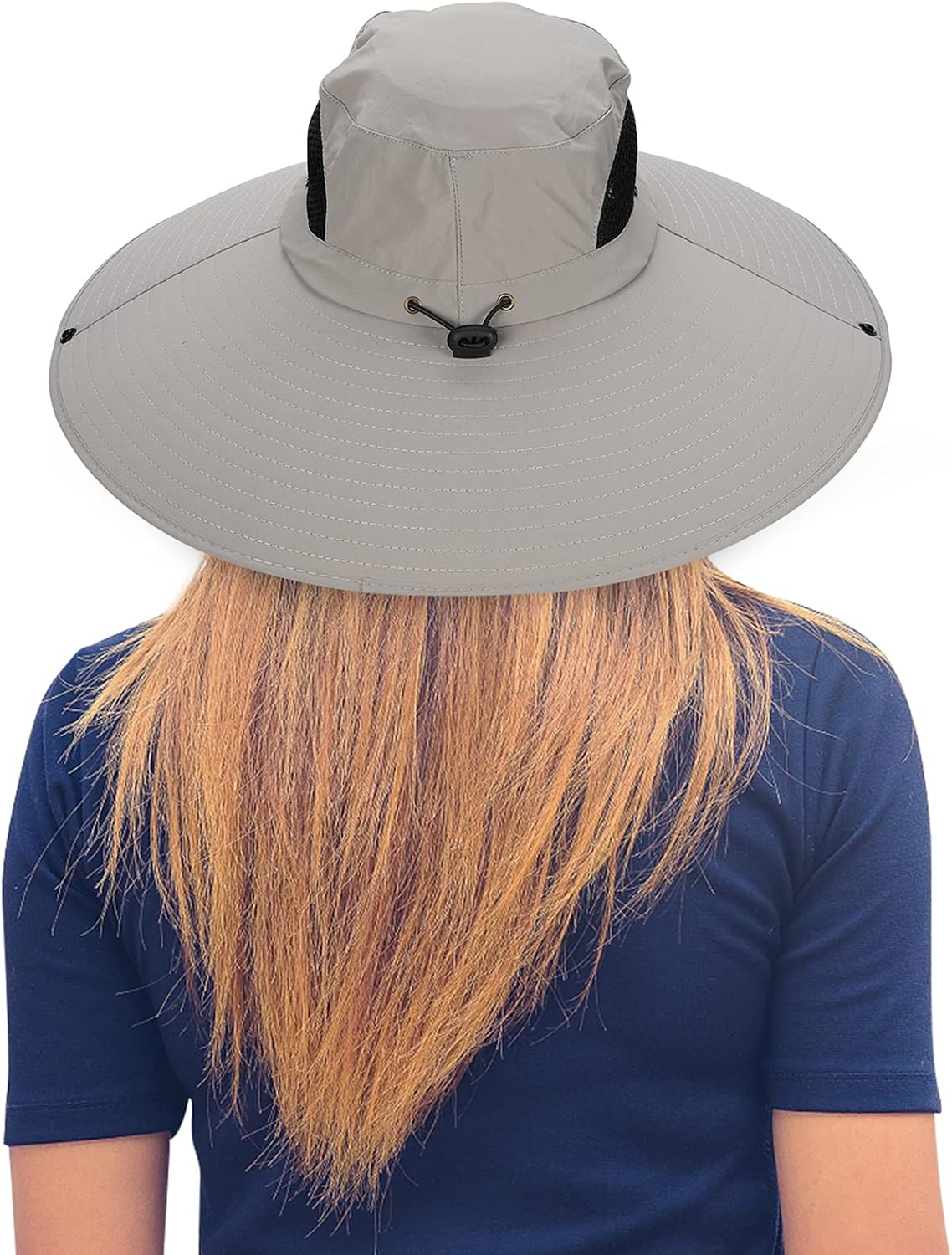
If you’ve recently started tretinoin (a prescription vitamin A cream that speeds up skin-cell turnover but makes skin dramatically more vulnerable to UV damage in the process), or you’re managing rosacea (a chronic skin condition where sun exposure triggers redness, flushing, and inflammation), or you’ve just finished a laser or chemical peel treatment — your dermatologist has almost certainly said some version of: stay out of the sun, and if you go outside, protect your face. Sunscreen is the foundation. But a hat that genuinely blocks UV rather than just shading your eyes is the layer that matters when you’re outside for more than a few minutes. This guide breaks down what your skin’s actual situation demands from a hat — in terms of UPF rating, brim width, fiber choice, fit, and construction details that reviewers with the same conditions have flagged as the difference between adequate and genuinely protective.
| EDITOR'S PICKLeotruny Women Super Wide Brim… | Mid-tierFURTALK Womens Sun Straw Hat Wi… | Budget pickZOORON Women's Ponytail Safari… | |
|---|---|---|---|
| Material | — | Straw | — |
| UPF Rating | UPF50+ | UPF 80 | UV Protection |
| Packable | — | ✓ | ✓ |
| Size | One Size | Medium-Large | 6 3/4-6 7/8 |
| Waterproof | ✓ | — | — |
| Ponytail Hole | — | — | ✓ |
| Price | $24.99 | $23.39 | $9.98 |
| See on Amazon → | See on Amazon → | See on Amazon → |
What “Medically Sensitive” Skin Actually Demands from a Hat (and Why Most Sun Hats Don’t Deliver It)
The phrase “sun hat” covers a huge range of products — a loosely woven straw hat from a gift shop and a tightly woven UPF 50+ wide-brim are both “sun hats.” For most people, the gift-shop version is fine. For someone on tretinoin or photosensitizing medications (a broad category that includes some antibiotics, certain acne drugs, diuretics, and rosacea treatments), or someone with a sensitized post-procedure complexion, the gap between those two hats is genuinely clinical.
Here’s the tradeoff frame that matters:
UPF (Ultraviolet Protection Factor) is the fabric equivalent of SPF — it tells you how much UV radiation the textile blocks. Per the Skin Cancer Foundation’s guidance on sun-protective clothing, a UPF 50+ garment blocks at least 98% of UV rays. Standard unbleached cotton sits around UPF 5–15. A loosely woven straw hat may offer as little as UPF 3–5 at the weave, even if the brim is wide.
Brim width matters geometrically, not just aesthetically. The American Academy of Dermatology Association recommends a minimum 3-inch brim all the way around for meaningful facial coverage. Wider than that starts to matter when you factor in sun angle — the FDA’s guidance on UV-protective textiles notes that UV exposure is highest within the two hours on either side of solar noon, when the sun is higher in the sky and a narrower or flat brim casts less shadow on the nose, cheeks, and chin than you’d expect.
The downward-curve geometry question is one that owners of the Roxy hat have raised specifically: a brim that angles slightly downward (rather than sitting flat or curling upward at the sides) extends the shadow envelope meaningfully. One buyer doing desert field work noted that switching from a straight-brimmed hat to the Roxy’s curved brim produced a visibly larger shadow across the face at midday. For rosacea patients whose trigger is cumulative UV even at low intensities, that geometry difference is not cosmetic.
The UPF Number Decision Frame: When Does Higher Actually Matter?
This is the question owners ask most often: is UPF 80 meaningfully better than UPF 50 for someone on tretinoin?
The honest answer is: not in the way the number implies, but the conditions under which you’d hit that ceiling matter.
By the numbers:
| UPF Rating | UV Blocked | UV Transmitted |
|---|---|---|
| UPF 15 | 93.3% | 6.7% |
| UPF 50 | 98.0% | 2.0% |
| UPF 50+ | 98%+ | <2.0% |
| UPF 80 | 98.75% | 1.25% |
The practical gap between UPF 50+ and UPF 80 on a dry hat, in standard test conditions, is less than 1% transmission difference. Where UPF 80 earns its premium is in wet or stretched conditions — many fabrics lose 30–50% of their UV protection when wet, so a fabric rated UPF 80 dry may perform closer to UPF 40 wet, still comfortably above the clinical threshold. The Skin Cancer Foundation notes this explicitly in their guidance on UV-protective fabrics.
Owners of the FURTALK UPF 80 floppy hat — including at least one buyer with rosacea and ocular rosacea who was also on photosensitizing medication — report that the hat’s higher rating came into the decision when they were factoring in sweating, light rain, and the reality that the hat would be worn for hours. She described the unboxing and immediate wear as evidence of how urgent the need felt: “literally took it out of the box and put it on.” That instinct — to prioritize ceiling protection because conditions in real life won’t be lab-optimal — is sound reasoning for anyone whose skin is chemically sensitized.
Decision rule: If you’ll be wearing the hat dry, stationary, and in the shade most of the time, UPF 50+ is sufficient. If you’re sweating, near water, or active outdoors for extended periods, the headroom of UPF 80 fabrics is a genuine hedge.
The Ponytail Hole: Covered vs. Open Gap
This is a construction detail that’s easy to overlook until you’re standing in direct sun and realize the top of your scalp is exposed. For tretinoin users especially — whose scalp skin can also be sensitized — an open ponytail hole is a measurable gap in coverage.
Owners of the Solbari ponytail hat specifically called out the covered ponytail hole design as the deciding factor in their purchase. The construction routes the ponytail through a fabric-covered channel rather than a bare eyelet, so there’s no exposed scalp circle at the crown. This distinction matters:
- An open grommet-style ponytail hole leaves a roughly 0.5–1 inch diameter circle of scalp directly exposed to overhead sun.
- At solar noon with high UV index, even a small gap can deliver a meaningful dose to repeatedly exposed skin.
- For buyers whose dermatologist specifically flagged scalp protection, the covered hole isn’t a nice-to-have — it’s the specification.
The tradeoff is that covered ponytail holes are slightly warmer (less ventilation at the crown) and need to be sized correctly for your hair volume. Owners with thick or high-volume ponytails note that the channel needs to be sized generously enough not to compress the hair. Read size guidance carefully before committing.
Fiber Choices for Sensitized Skin: Natural vs. Synthetic at the Forehead Band
Here’s where the guide needs to be honest about a genuine tradeoff that doesn’t have a clean winner.
Natural fibers (straw, linen, cotton) feel intuitive for sensitive skin — they’re breathable, they don’t trap heat against the forehead band, and there’s no synthetic finish to worry about. The concern is that the weave structure of natural straw hats is often open enough that UPF at the hat’s body is significantly lower than the brim coverage suggests. Parisisal and papyrus straw, for instance, are genuinely beautiful and block meaningful direct sun — but their woven-grass structure under magnification reveals gaps that synthetic performance fabrics don’t have.
Synthetic performance fabrics (polyester blends, nylon weaves rated for UPF) deliver more consistent UV blockage because the weave density is engineered and doesn’t vary the way hand-woven naturals do. The tradeoff is breathability and comfort at the sweatband — synthetic fabrics against the forehead can trap heat and moisture more than cotton or linen.
Several reviewers on the Leotruny hat — which attracted a significant cluster of tretinoin users, some of whom noted a dermatologist recommendation as the direct trigger for purchase — describe the sweatband comfort as a reason the price premium felt justified. The interior lining at the band contact point is a specification worth examining for anyone who’ll wear the hat for hours.
The practical frame for sensitized forehead skin: Look for hats with a natural-fiber or moisture-wicking sweatband interior even if the shell is synthetic UPF fabric. A rosacea patient wearing a hat that traps heat against the face is potentially triggering the same inflammatory response they’re trying to protect against. Per the National Rosacea Society’s triggers survey, heat is one of the top three reported rosacea triggers — more common than direct UV exposure alone.
Keeping a Wide-Brim Hat On During Activity Without Coverage Gaps
The problem is mechanical and solvable, but it needs to be thought through before you’re outdoors and reaching to grab a hat that’s blowing off:
Chin cords and adjustable drawstrings are the baseline. Most serious UPF sun hats include them; many fashion-adjacent wide-brims don’t. If you’ll be moving — hiking, gardening, working outdoors — a hat without a chin cord is a liability.
Adjustable internal drawstrings (separate from chin cords) let you tighten the hat’s circumference so it sits firmly without relying on the chin cord at all. This is a comfort-forward solution for lighter wind conditions.
The brim geometry question returns here. A floppy brim that catches wind like a sail will need a chin cord constantly. A hat with a structured brim that holds its shape — including a slight downward taper — creates less wind resistance and stays put better. Owners doing field work consistently report this as a functional geometry difference, not just a style one.
Wire-brim or shape-memory brim structures let you mold the brim downward on the windward side while still wearing it — a practical adaptation for variable-wind outdoor situations.
What “Waterproof Coating” Means for Breathability
Some performance sun hats carry a DWR (durable water repellent) coating — a hydrophobic finish that causes water to bead rather than soak into the fabric. The tradeoff is real:
- DWR coating helps maintain UPF performance when you sweat or are caught in light rain (because wet fabric loses UPF rating, as noted above).
- But DWR coatings reduce breathability at the fabric surface — moisture vapor from your head has a harder time escaping.
- For someone managing rosacea who is trying to minimize heat buildup at the face and scalp, a fully coated hat may be counterproductive if worn for hours.
The practical recommendation: DWR coating is most valuable on the brim and outer crown, less desirable at the sweatband and inner lining. Look for hats where the coating is exterior-only and the interior retains natural breathability.
Frequently Asked Questions
Does a higher UPF number actually mean meaningfully better protection for someone on tretinoin? At the top of the scale, the absolute protection difference is small — less than 1% transmission between UPF 50+ and UPF 80 under ideal conditions. Where higher UPF earns its keep is in real-world degraded conditions: wet fabric, stretched fabric, extended wear. For tretinoin users whose skin photosensitivity can be significant, the headroom is a reasonable hedge.
Does a ponytail hole compromise UV protection at the crown? An open grommet-style hole does create a measurable exposure point at the scalp. A covered ponytail channel — like the design owners cite on the Solbari ponytail hat — eliminates this gap. If scalp protection matters for your condition, the covered design is the specification to prioritize.
Is natural fiber (straw, linen) safer against a sensitized forehead than synthetic? Natural fibers are generally more comfortable at skin contact and less likely to trap heat — relevant for rosacea patients who need to avoid thermal triggers. But natural-fiber hats often have lower and less consistent UPF ratings than engineered synthetic fabrics. The best solution is a synthetic-shell hat with a natural-fiber or moisture-wicking interior sweatband.
How do I keep a wide-brim hat on during outdoor activity when I can’t afford gaps in coverage? A chin cord is the primary tool. A hat with an adjustable internal drawstring adds a secondary fit layer. A structured brim that doesn’t catch wind as aggressively as a fully floppy brim reduces the need to rely on either. All three together give you reliable coverage through active movement.
What does ‘waterproof’ coating mean for breathability in a hat I’ll wear for hours? DWR (durable water repellent) coatings protect UPF performance in wet conditions by preventing fabric saturation, but they reduce moisture-vapor escape from the hat’s interior. For extended wear — especially by rosacea patients managing heat as a trigger — look for exterior-coated brims paired with breathable, uncoated interior lining rather than a fully waterproofed hat.